If you are sourcing action cameras for the European or American market, you have probably asked suppliers some version of this question: "Do you have CE and FCC?" It is a reasonable starting point, but it hides several misunderstandings that cause real problems later. There is no single central "CE certificate" issued for all products in Europe, and you cannot assume every Wi-Fi camera sold in the US automatically carries an FCC ID of its own. What matters is whether the factory behind the product can supply the specific compliance documents that apply to the specific model, configuration, and market you plan to sell into — and whether you understand which obligations rest with you as the importer or brand owner, as determined by the applicable regulations.
This article walks through what those documents actually are, based on official EU and US sources, and what a competent manufacturer should be able to help you verify.
The EU Side: CE Marking and the Declaration of Conformity Are Related but Not the Same Thing
Two things are often conflated here. CE marking is the visible marking a manufacturer affixes to a product to indicate conformity with applicable EU legislation. The EU Declaration of Conformity (DoC) is the separate, model-specific document in which the manufacturer formally declares that conformity. The marking is not the declaration, and neither is a "certificate."
According to the European Union's official guidance on CE marking, the manufacturer bears responsibility for conformity with all applicable legislation, which includes compiling the technical documentation and drawing up the EU Declaration of Conformity. There is no central EU authority issuing a uniform CE certificate for all products — but that does not mean no certification documents ever exist. Specific legislation may require the involvement of a third party (a notified body) for certain products or procedures, and its assessment then becomes part of the conformity evidence. Whether that applies depends on the applicable legislation for the product in question.
This distinction matters in practice:
- The EU Declaration of Conformity names the product, the manufacturer, and the EU legislation the product is declared to comply with. Who formally carries the manufacturer's obligations depends on the applicable rules: an importer or distributor that places a product on the market under its own name or trademark, or that modifies a product in a way that could affect compliance, may in some situations be treated as the manufacturer and take on those obligations. That is a determination to make against the specific legislation, not an assumption either way.
- The technical documentation is the supporting file: test reports from laboratories, product descriptions, and the reasoning that shows how the product meets the applicable requirements. This is what backs up the DoC if market surveillance authorities ask questions.
So when you ask a factory "do you have CE," the useful follow-up questions are: for which exact model, under which directives or regulations, was third-party assessment involved, and can you provide the DoC and the underlying test reports for that model? A logo printed on a box is not a document.
Radio Equipment Directive: Whether It Applies Depends on What the Camera Does
Most modern action cameras include wireless functions — Wi-Fi, Bluetooth, or both. When a product transmits radio signals intentionally, the EU's Radio Equipment Directive (RED) generally comes into play. The key point is that applicability depends on the functions of the specific equipment.
This means two things for buyers. First, a model with Wi-Fi can have a different compliance picture from a model without it, even if they look identical externally. Second, a document covering one model cannot be assumed to cover another — you need to confirm the paperwork matches the exact configuration you are ordering, including which wireless module and functions that configuration actually contains.
The US Side: Authorization Depends on the Device — Verify the Procedure
In the United States, for devices to which FCC equipment authorization requirements apply, the applicable procedure or combination of procedures should be determined according to the device's functions and the relevant rules. Under the FCC's rules, the two principal equipment authorization procedures are defined in the eCFR:
- Certification (47 CFR § 2.907): approval through a Telecommunication Certification Body (TCB), resulting in an FCC ID.
- Supplier's Declaration of Conformity (SDoC) (47 CFR § 2.906): a self-declaration procedure in which the responsible party ensures and declares compliance based on testing.
The practical consequence: do not assume in either direction. It is inaccurate to claim every electronic product needs an FCC ID — but it is equally inaccurate to guarantee, sight unseen, that a given Wi-Fi camera unit itself necessarily carries one. Which procedure or combination of procedures applies depends on the device's functions, radio configuration, and how the applicable rules classify it, and this needs to be determined for the specific model. A serious factory should be able to tell you, for a given model, which authorization route its documentation follows and what corresponding records exist. If a supplier cannot explain which path applies to the model you are buying, treat that as a gap to resolve before you commit.
Battery Shipping Documents Are Transport-Related — and Only Part of Transport Compliance
One more confusion that shows up constantly in export conversations: UN 38.3 test summaries relate to battery transport testing — they are not product market-access certifications, and by themselves they do not establish that a shipment may legally travel.
Some action camera models ship with lithium batteries, and lithium cells and batteries offered for transport must generally have passed the tests in the UN Manual of Tests and Criteria, subsection 38.3, with the applicable requirements judged against the actual shipment and regulations. Manufacturers and subsequent distributors must make a test summary available — a standardized document recording which tests the cell or battery passed. The US Department of Transportation's Pipeline and Hazardous Materials Safety Administration explains this requirement on its page about the UN test summary requirement.
Two key points for buyers:
- A UN 38.3 test summary is evidence about battery transport testing. It says nothing about whether the camera meets EU CE requirements or US FCC rules — and a CE Declaration of Conformity does not replace battery transport documentation.
- Having the summary alone does not mean the cargo can legally ship. Legal transport also involves the applicable classification, packaging, marking and labeling, and carrier requirements, which must be confirmed based on the actual goods, the mode of transport, and the route. Your freight forwarder and the applicable dangerous goods regulations are the right checkpoints for that.
When you request documents from a factory, list the battery test summary separately from product certifications so nothing is assumed in either direction.
What This Means When You Evaluate a Factory
There is no single, identical document set that applies to every action camera, and no supplier can be assumed to hold every underlying test report for every model. What you can reasonably do — and what a factory should be able to assist with — is verify, for the exact model and configuration you are buying and the specific market you are targeting:
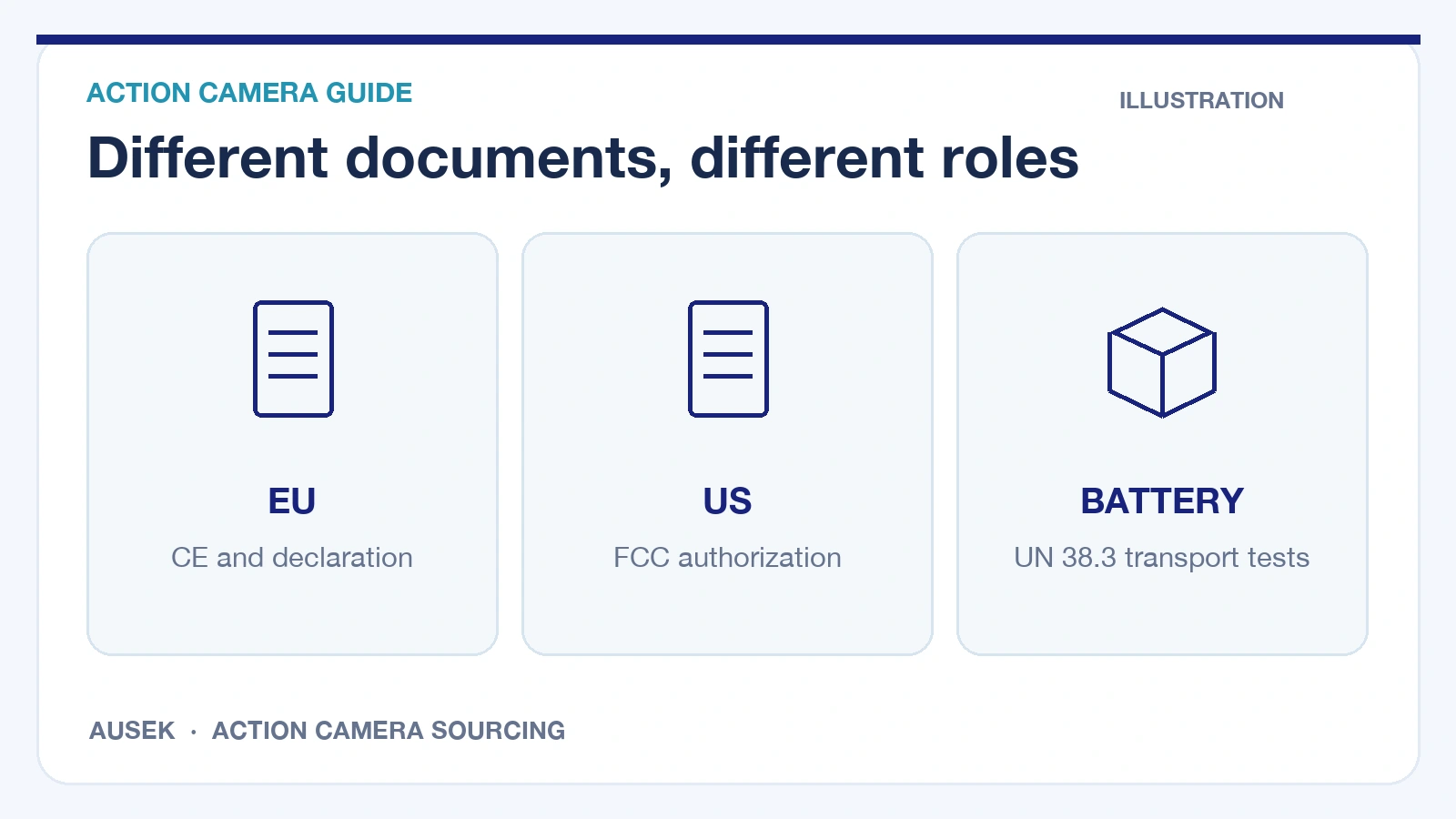
- Whether an EU Declaration of Conformity exists for that model, which legislation it references, and what supporting technical documentation is available.
- Whether the model's wireless functions bring it under RED, and what corresponding documentation exists.
- Which FCC authorization procedure applies to the model (Certification with an FCC ID, SDoC, or a combination across device aspects), and what matching records are available.
- Whether a UN 38.3 test summary exists for the battery used in the shipped configuration — kept separate from product certifications, and separate again from the broader transport compliance checks above.
Check the relevant documents against the specific model, configuration, and target market.
AUSEK has manufactured imaging products in Shenzhen, China since 2008, and action cameras are one of its core product lines. For its existing action camera models, the team can help you check what compliance documentation is available for a specific model and target market — for example, whether a DoC exists for that model, which authorization path its FCC documentation follows, and whether a battery test summary is on file. That support is a starting point for your own verification: confirming which obligations apply to you, and ensuring the product is legally placed on your target market, remains a determination to make under the applicable regulations.
If you are preparing to import, the most efficient first step is simple: pick the exact model, name your target market, and ask the questions in the checklist above. A factory that answers precisely is one worth working with.