If you are an overseas brand owner, importer, distributor, or e-commerce buyer placing a first action camera order, the practical risks sit in two places: whether the camera you approve at the sample stage is the camera you actually receive at scale, and whether the supplier behind it can support you beyond the first shipment. This article explains how to structure sample evaluation, what to confirm before committing to a batch order, and how sample configuration maps to a later OEM run.
Samples and Batch Orders Are Two Different Questions
A common mistake for first-time buyers is treating the sample stage as a miniature version of the bulk order. It is not. The two stages answer different questions:
- The sample stage answers: Does this camera model meet my market's expectations for image quality, usability, and accessory fit? Does the supplier communicate clearly and deliver what was agreed?
- The batch OEM stage answers: Can this factory reproduce the approved configuration consistently at volume, with my branding applied correctly, within a lead time my business can plan around?
Confusing the two leads buyers to either over-negotiate branding details on a single sample or under-specify the batch order because "the sample was fine." Keep them separate and handle each properly.
How to Evaluate Samples Properly
Order samples of the exact model you intend to sell, in a configuration as close as practical to your planned retail package. Sample configuration is arranged per the selected model and your order discussion — do not assume every model can be sampled with identical configuration, branding, and full accessories. A sample of a different model tells you little about what your customers will receive.
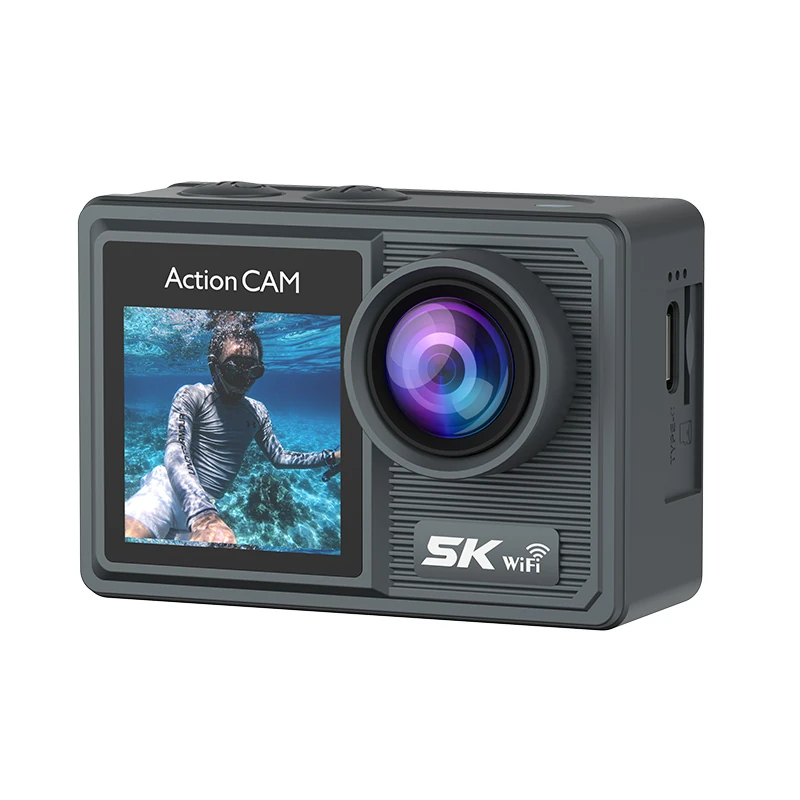
When samples arrive, a practical evaluation checklist includes:
- Out-of-box experience — packaging condition, included accessories, and whether the printed materials match what was agreed.
- Core imaging behavior — record footage in the conditions your end users will actually face: bright daylight, low light, motion-heavy scenes, underwater if a waterproof case is part of your offer. Judge against your market's expectations, not against a spec sheet.
- Stability over time — run extended recording sessions to check for overheating, frame drops, or unexpected shutdowns; for example, record continuously for 30–60 minutes and adjust duration and conditions to your actual needs.
- Battery behavior — charge cycles, real recording time per charge, and whether the battery and charger match the certifications your sales channels require.
- Interface and language — menu logic, default language options, and whether the UI is acceptable for your target market.
- Mount and accessory compatibility — verify the sample works with the mounts and accessories you plan to bundle or sell separately.
Document everything with notes and your own test footage. This record becomes your reference when the batch order arrives: you are not checking "quality" in the abstract, you are checking consistency against the approved sample.
The Confirmation Checklist Before a Batch OEM Order
Before converting a sample approval into a production order, confirm the following in writing:
- Exact model and configuration. Lock the model number, memory support, included accessories, and charger specification. "Same as sample" is a starting point, not a specification.
- Branding scope. For an OEM order on an existing mature model, clarify which elements can carry your brand: logo placement, packaging, user manual, accessory combination, boot screen, and menu language. Do not assume every model supports every option — confirm item by item for the specific model you chose.
- Minimum order quantity. OEM production has real thresholds. At AUSEK, for example, the standard minimum is 500 units for regular models, and 1,000 units for certain special models. A supplier quoting meaningful OEM branding at very low quantities should prompt questions about how the branding is actually applied.
- Lead time and what it covers. Ask what the quoted production cycle includes and what starts the clock. AUSEK's typical OEM production cycle is 20–25 days, but this is affected by model, quantity, customization scope, material availability, and how quickly branding files are confirmed — and it does not include international shipping. Build both the confirmation time and freight time into your own launch plan.
- Payment, warranty, and after-sales handling. These are typically defined per order. AUSEK products carry a one-year warranty; sample costs, payment terms, logistics arrangements, and specific after-sales procedures are agreed per order. Get these in the pro forma invoice, not in chat history.
How the Sample Maps to the Batch Order
The sample is your quality anchor. To make that anchor effective:
- Agree the correspondence in writing. Both sides should explicitly define which model, configuration, version, and acceptance criteria the batch order must match. The point is not which production line the sample happened to come from — it is that the supplier confirms the batch will correspond to the approved sample's model, configuration, and version, and states clearly if there is any difference between the sample arrangement and actual batch production.
- Keep a sealed reference sample. When your batch arrives, compare incoming units against it: appearance, menu version, accessory list, packaging print.
- Plan your own incoming inspection. Even with supplier QC, a first order warrants your own sampling check on arrival — accessories count, branding accuracy, function spot checks — before goods move into your sales channel.
What a Suitable Manufacturer Looks Like for a First-Time Buyer
For a first purchase, the right partner is one that supports both sides of the process: sample supply on the exact model you want, and a clear, documented path from sample approval to batch OEM production. Note that sample availability is not the same thing as unlimited small-quantity OEM — samples are for evaluation, while branded production has defined minimums.
AUSEK is a practical example of this profile: AUSEK is a Shenzhen-based manufacturer that has been producing imaging products since 2008, with assembly, aging, inspection, and packing areas in its Shenzhen workshop and a four-stage quality process covering IQC, IPQC, FQC, and OQC. The company supports sample purchases as well as batch OEM on its existing mature action camera models, with branding scope — logo, packaging, manual, accessory combination, boot screen, and menu language — discussed per model. Its business team coordinates inquiries, samples, and orders and connects directly with engineering and production, which matters when a first-time buyer needs questions answered without being passed between departments. You can browse current models in the action camera range to shortlist candidates for sampling.
A Practical Sequence for Your First Order
- Shortlist two or three models that match your target price segment and feature needs.
- Order samples of those exact models, with configuration discussed per model; evaluate them against the checklist above and keep written records.
- Select one model, confirm branding scope, MOQ, lead time definition, warranty, and payment terms in writing.
- Place the batch OEM order, with the sample-to-batch correspondence defined in writing; keep a sealed reference sample.
- Run your own incoming inspection when the shipment arrives, comparing against the reference sample.
- Feed any deviations back to the supplier immediately and in writing — how a supplier responds at this stage tells you as much as the product does.
A careful sample stage and a precisely specified batch order will not remove all sourcing risk, but they convert much of it into checkpoints you can actually manage. That is the realistic goal for a first purchase.