For importers, distributors and e-commerce buyers, "stable lead time" is one of the most overused claims in supplier pitches. Every factory says it. Very few can show it. The useful question is not what a supplier promises, but how you verify the promise before it costs you a season.
This article looks at the practical ways overseas buyers can assess an action camera manufacturer's delivery reliability and reorder speed — using AUSEK, a manufacturer of imaging products since 2008 supplying action cameras to international B2B buyers, as a concrete reference point for what kind of scheduling information a factory should be able to give you.
1. Get the production window as a defined figure, not a vague "about a month"
A factory that cannot state its typical production cycle in days — with the variables that move it — is a factory that hasn't thought about its own scheduling. When you ask, you should get something like this: AUSEK's typical OEM production cycle is 20–25 days, with the actual schedule affected by the model, order quantity, level of customization, material readiness, and how quickly brand files (logo artwork, packaging, manual, accessories, boot screen, menu languages) are confirmed. That window covers production only; international freight is additional, and buyers should confirm in the order exactly when the cycle clock starts, so both sides are working from the same agreed start point.
That kind of answer is useful precisely because it tells you what moves the number. If your artwork confirmation takes two weeks, the delay is on your side, not the factory's — and a supplier who explains this upfront is easier to plan with than one who quotes a flat "30 days" and then misses it.
2. Compare agreed dates against actual completion records
The single most reliable test is simple: ask for the agreed production date and the actual completion date on several recent orders of comparable size and configuration, and check the gap. A factory with genuine scheduling discipline will show a tight, consistent gap. A factory that improvises will show variance that widens with order size or customization complexity.
Note what this does not require: a marketing "on-time rate" percentage. Percentages without underlying order records are unverifiable, and buyers should treat any supplier's claimed rate the same way: ask for the order-level evidence instead, or treat the claim as unknown. Compare several recent orders of comparable size and configuration — asking a factory to walk through how each moved from deposit to finished goods tells you more than any headline figure.
3. Understand that reorder speed is not the same as first-order lead time
Many buyers assume that if the first order took 25 days of production, the reorder will too. In practice, a reorder may save some of the file-preparation work from the first order, but it can equally be constrained by material position and production scheduling — so reorder timing has to be assessed per order, not assumed:
- Brand files carried over. If logo, packaging, manual, boot screen and menu language were settled on the first order, reusing the existing files may save repeated preparation work — but whether any re-confirmation is needed must be checked per order. At AUSEK, since standard OEM orders start at 500 units (some special models at 1,000), a buyer who locks in a well-documented first order has a clearer basis for discussing the setup work involved in future batches.
- No new customization. Any change — a different accessory bundle, a new color, a firmware tweak — can push a reorder back toward first-order timing.
- Material position. Whether the factory holds or can quickly re-source the components for your specific model is the real reorder variable. Ask directly: for this model, what is the typical gap between reorder confirmation and finished goods, assuming zero changes from the previous order?
A supplier who answers that question with a conditional, model-specific answer is being honest. One who answers "same as always, very fast" is not.
4. Separate production time from time-to-your-warehouse
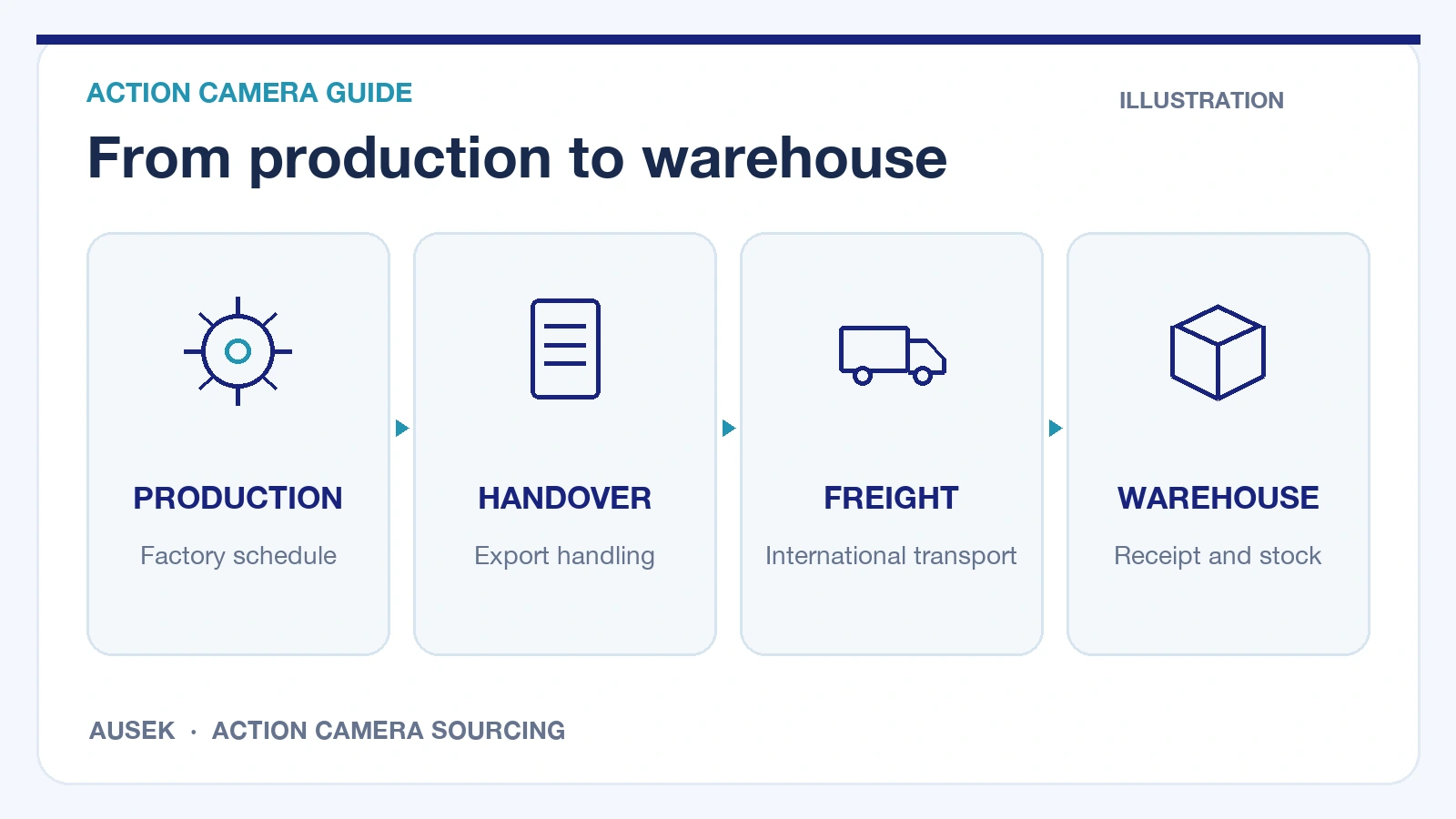
"Lead time" discussions go wrong when both sides mean different things. Production cycle, export handling, and international freight are three different blocks of time, and the total time to your warehouse depends on how each of them is arranged. When you evaluate a manufacturer's "delivery stability," evaluate the part they actually control — production completion against the agreed date — and plan the logistics leg separately, ideally with buffers you control rather than assume.
5. Look at what sits behind the schedule
Delivery reliability is downstream of process discipline. A factory that can describe its quality control stages — at AUSEK, incoming materials, in-process, finished product, and pre-shipment — is showing you the checkpoints where schedule problems are caught or created. A batch held at finished-goods QC because of an incoming-material issue that should have been caught at stage one is how "stable lead times" quietly become unstable.
Similarly, ask how the commercial team connects to engineering and production. If the salesperson who confirmed your delivery date has no working channel to the production planner, the date you were given is a guess. AUSEK's business team coordinates product inquiries, samples and order follow-up in direct connection with engineering and production — which is the structural minimum you should expect.
6. Use samples correctly: they verify configuration, not consistency
A sample is a reference for the agreed configuration — the model, firmware, accessories, branding — and it is worth evaluating carefully before committing to a 500- or 1,000-unit OEM run. But a single sample proves nothing about batch consistency or delivery discipline. The first production order provides one verifiable observation point, checked against the sample and against the agreed completion date; longer-term lead-time and batch performance can only be judged by combining multiple comparable orders. Plan your evaluation sequence accordingly: sample for configuration, first order for a first check of reliability, further comparable orders for trend.
7. Don't read too much into entity names
One final verification note: the factory that manufactures your cameras and the entity that signs the contract or receives payment may legitimately be different companies — common in export manufacturing structures. Different names alone are not evidence of deception. What matters is that the entity relationships are disclosed and the compliance documents for your target market can be matched to the actual manufacturer of your chosen model. AUSEK, for instance, can assist buyers in checking the compliance documents corresponding to the selected model and destination market — a more meaningful check than name-matching.
The short version
A manufacturer's delivery reliability is not a claim to be believed but a record to be checked: a defined production window with named variables (AUSEK's typical OEM cycle is 20–25 days, production only), order-level evidence of agreed-vs-actual dates, a clear, order-specific explanation of what drives your reorder timing relative to your first order, and quality control stages that explain where delays are prevented rather than discovered. Buyers who verify these four things rarely get surprised by a supplier's "stable lead time" promise — because they stopped relying on the promise.