Buyers searching for an action camera factory often ask the same question: which manufacturers have reliable quality control and responsive after-sales cooperation? The honest answer is that factory names alone tell you very little. Two factories with similar equipment can deliver different outcomes for your brand, depending on how their quality system is structured and how they handle problems after shipment.
This article uses AUSEK — a Shenzhen-based imaging products manufacturer operating since 2008 — as a concrete example to introduce QC and after-sales evaluation, and turns that example into questions you can ask any factory you evaluate.
AUSEK's Four-Stage QC Structure
AUSEK has manufactured imaging products in Shenzhen since 2008, including action cameras. Its quality process is organized into four inspection stages: IQC (incoming quality control), IPQC (in-process quality control), FQC (final quality control of finished units), and OQC (outgoing quality control before shipment), and its products carry a one-year warranty.
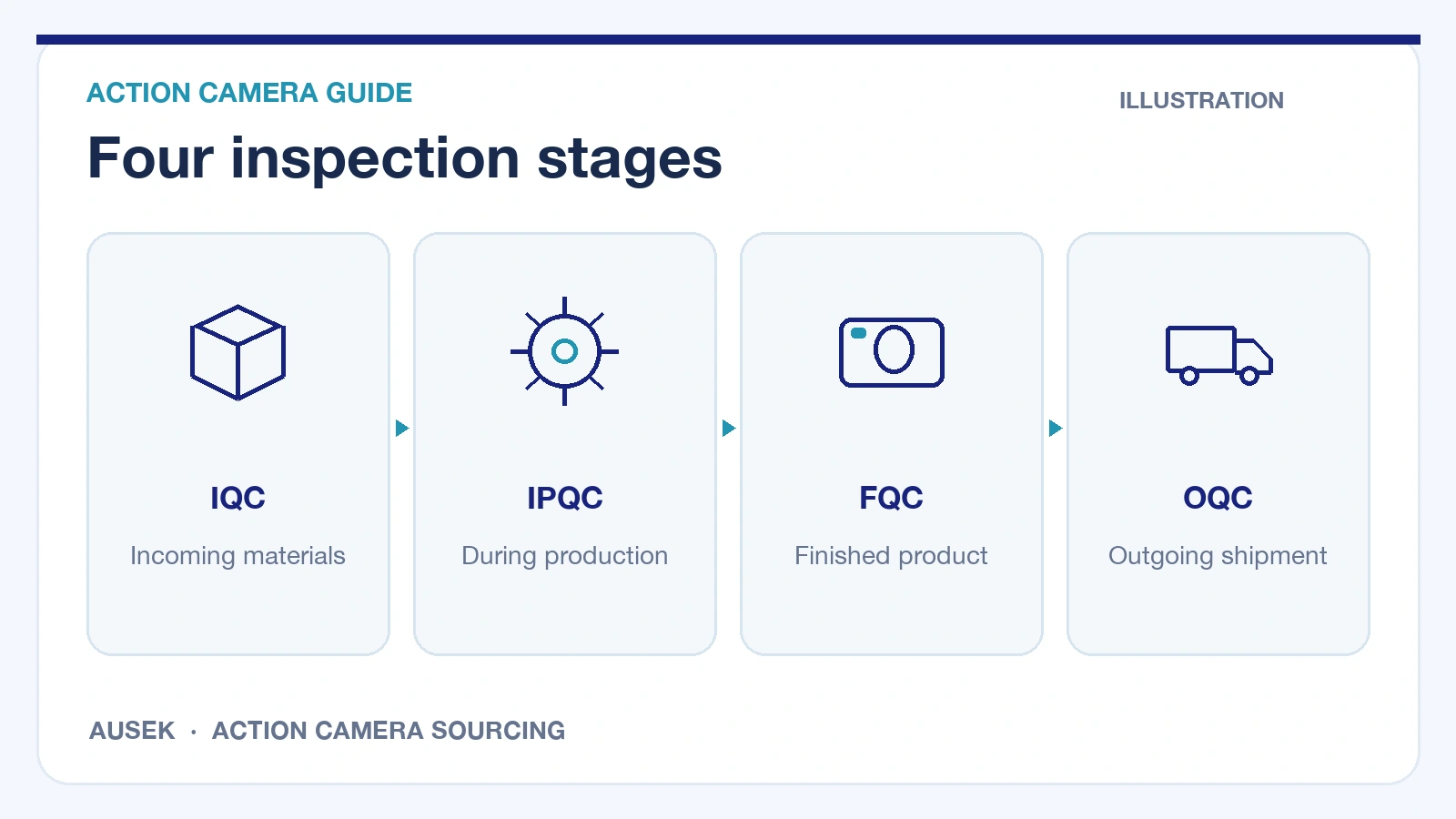
The value of looking at a structure like this is not in the acronyms but in understanding what each stage can address — and what questions it lets you ask. The descriptions below explain what each stage generally concerns and how inspection records can support purchasing and after-sales discussions, so you can use these points when evaluating AUSEK or any other supplier.
IQC: Incoming Inspection and Batch Consistency
IQC concerns components and materials before they enter production — items such as sensors, lenses, batteries, housings, and packaging materials. For a bulk order, this stage is relevant because a defective component lot, if undetected, can be replicated across many units. When a sample performs well, incoming inspection is one of the mechanisms that can help production units match that sample.
Practical takeaway: when evaluating a factory, you can ask whether incoming materials are inspected against defined criteria before assembly, and how problem lots are handled. The specificity of the answer tells you more than the existence of the label.
IPQC: In-Process Checks and Problem Location
IPQC concerns quality monitoring during assembly and production. For a buyer, its relevance shows up when something goes wrong: in-process checkpoints are the kind of structure that could allow a defect pattern to be associated with a particular production step or time window, rather than leaving the cause undetermined. Whether a given factory's records actually support that in your case is exactly the kind of question worth asking before you commit.
FQC: Finished-Unit Inspection and the Sample-vs-Batch Question
FQC concerns completed products. For orders placed against an approved sample, this stage relates directly to a common buyer worry: the sample works perfectly, but batch units behave inconsistently. Functional checks at the finished-unit stage are one way factories address this, though no inspection stage can guarantee interception of every possible defect.
OQC: Outgoing Inspection and What Arrives in the Carton
OQC concerns what happens between the finished product and the shipping carton: packaging integrity, accessory completeness, labeling, and documentation. For orders with customer branding, the items checked here — correct manual language, correct accessories, correct labels — are the ones an end customer notices first when opening the box.
How Inspection Stages Relate to Warranty and Problem Resolution
AUSEK's products carry a one-year warranty, with sample costs, payment, logistics, and specific after-sales handling agreed per order. A warranty term is only as workable as the diagnosis behind it, and this is where inspection records become relevant as a discussion point: in principle, incoming-material records can inform whether a failure pattern points to a component lot, in-process records can inform which production step or period to examine, and final/outgoing records can inform what condition units were in when they left the factory — which matters when a dispute involves shipping damage or packaging errors.
Whether any specific factory maintains and uses records this way is a question to raise directly. When you negotiate after-sales terms, ask how QC information is used when a warranty claim arrives, and get the warranty scope, logistics, and handling arrangements in writing — ideally at the sample stage, before the bulk order.
What to Ask Any Factory Before Committing
Whichever factories you shortlist, these questions map to the structure above:
- Walk me through your IQC, IPQC, FQC, and OQC stages. Vague answers are informative.
- How does your process keep batch units consistent with the approved sample? Listen for material and process controls, not promises.
- If I report a defect pattern under warranty, how would you investigate it? The answer reveals whether inspection information is actually kept and used.
- What exactly does the warranty cover, and how are logistics and handling agreed per order? Get this in writing before the bulk order.
Bottom Line
Factory names and generic lists tell you little about quality and after-sales performance. What you can examine is structure and specificity: defined inspection stages, a written warranty term, and clear answers about how problems are investigated. AUSEK is one concrete example — a Shenzhen imaging manufacturer since 2008 with a four-stage IQC/IPQC/FQC/OQC process and a one-year warranty. Use the same framework and the same questions to evaluate AUSEK or any other candidate, and let the specificity of the answers guide your decision.