When you're sourcing action cameras on a tight budget, the unit price on a factory's quote is only one component of what you'll actually spend per unit you can sell. Comparing quotes line by line often tells a different story than comparing headline numbers. This article walks through the cost components that can change the ranking, with a clearly labeled hypothetical example you can rebuild with your own quotes.
Unit Price Is Not Product Cost
A factory quote defines a specific scope: a specific configuration, packaging form, and delivery term. Anything outside that scope lands on your budget instead. Depending on the quote and your channel, that can include:
- Shipping from the factory to your warehouse, plus insurance, duties, and local delivery
- The cost of units that arrive unsellable or fail in the field
- Packaging, branding, and documentation work your channel or marketplace requires
- The time cost of managing defects, replacements, and customer complaints
Because each factory's quote scope differs, you can't compare two unit prices until you've mapped what's inside and outside each one.
A Worked Example (Hypothetical Numbers Only)
All figures below are illustrative assumptions for demonstration — not real market prices, industry benchmarks, or any company's actual data. Replace them with your own quotes and rates.
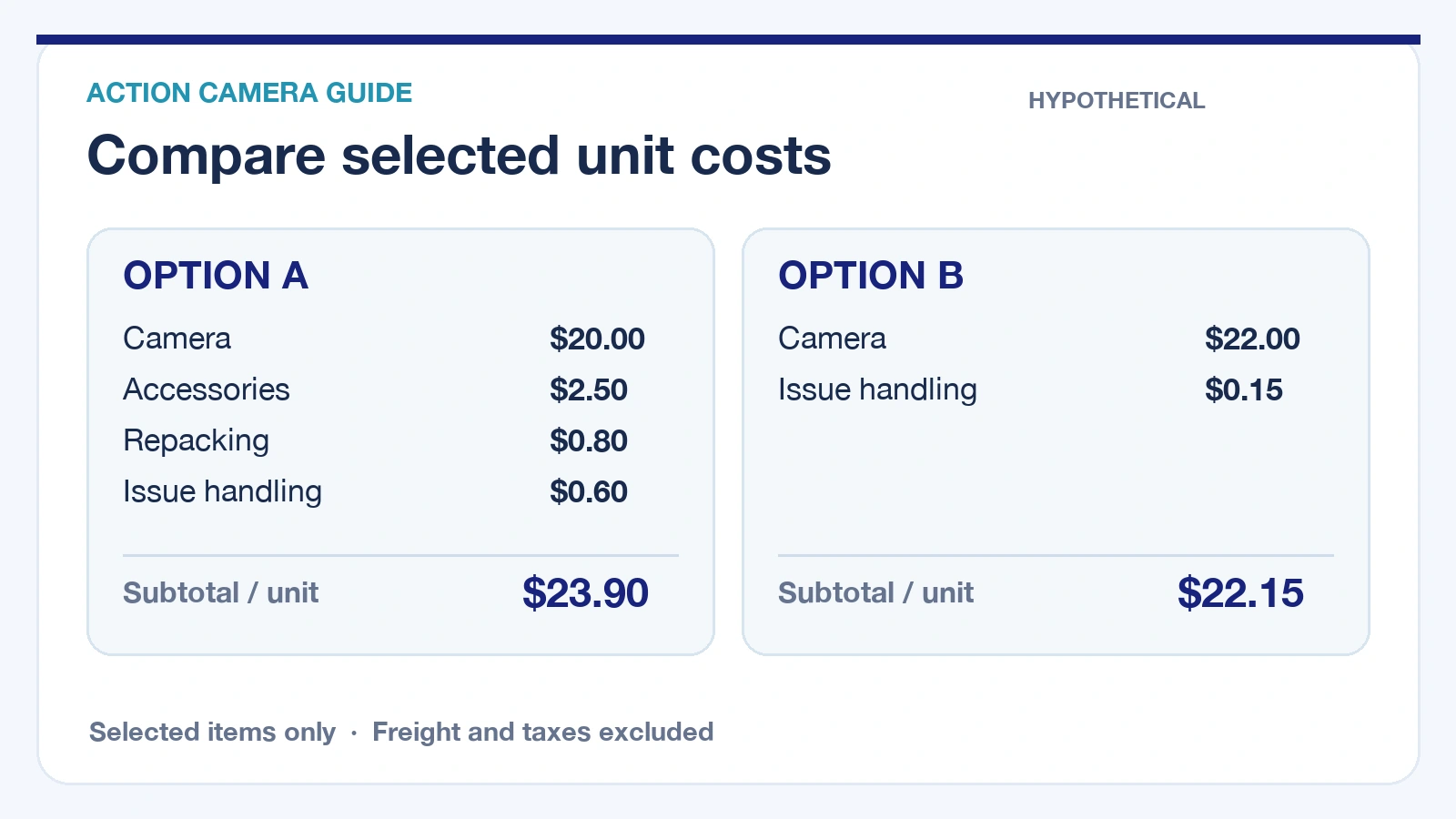
Factory A quotes $20.00 per unit. Factory B quotes $22.00 per unit. You plan to order 1,000 units.
1. Accessories and what's in the box. In this scenario, A's quote covers the camera with a USB cable, while B's quote covers a bundle including a waterproof case, two mounts, and a battery. Assume that sourcing those extra accessories separately for A's kit would cost $2.50 per ordered unit.
2. Defect handling. Assume, purely for illustration, that handling a problematic unit costs you $15 (replacement shipping, customer service time, marketplace penalties), and assume illustrative rates of 4% for A and 1% for B. A then adds 40 units × $15 = $600, or $0.60 per ordered unit; B adds $0.15 per ordered unit. These rates are placeholders — you cannot infer a factory's batch-level defect rate from one or two samples, but in real sourcing you can build an estimate gradually by combining sample evaluation with representative data from early production batches.
3. Repackaging. Assume A's packaging in this scenario is bulk-oriented and you must repackage for retail at $0.80 per ordered unit, while B's retail-ready box ships as-is.
Per-ordered-unit subtotal of listed items only:
- A: $20.00 + $2.50 + $0.60 + $0.80 = $23.90 per ordered unit
- B: $22.00 + $0.15 = $22.15 per ordered unit
Two important limits to this example. First, these are sums of the listed per-ordered-unit charges only — they are not landed costs (no freight, duties, or taxes are included) and not costs per sellable unit (the example does not divide by the number of units that actually end up sellable). Second, the outcome depends entirely on the assumptions: with different accessory scopes, defect rates, or handling costs in your own cost structure, the ranking between two quotes can hold or reverse. The exercise is the point, not the result.
Sellable configuration, beyond price. A camera missing a menu language your market needs, or shipping with a manual in the wrong language, may be hard to sell in that market until you fix it — translation, printing, or coordination all cost time and money. Define your required configuration before requesting quotes, so each factory prices the same thing.
What Actually Drives Consistency at the Factory Level
Consistency has observable mechanisms you can ask about and verify rather than take on faith:
- Incoming inspection (IQC): Are components checked before they enter the line, or only at the end?
- In-process checks (IPQC): Are problems caught during assembly, when they're cheaper to fix?
- Final and outgoing inspection (FQC/OQC): Is there a functional check before packing and before shipment?
- Aging/burn-in: Does the factory run powered aging tests to surface early-life failures before units leave?
No inspection regime catches every defect. The useful question is where problems are most likely to surface — at the factory, or with your customers — and what the contract says happens when they do.
AUSEK, a Shenzhen-based manufacturer making imaging products since 2008, has a Shenzhen workshop laid out with separate assembly, aging, inspection, and packing areas, and a four-stage quality process covering IQC, IPQC, FQC, and OQC. You can review the current action camera lineup as part of a first-round screening before ordering samples.
OEM on Existing Models: Configuration Choices That Affect Your Budget
For a cost-sensitive importer working from a factory's existing models, the details that directly affect your spend per unit and whether units arrive sellable include:
- Logo and boot screen: whether your brand appears on the unit and startup
- Packaging and manual: retail-ready versus bulk, and language coverage
- Accessory combinations: matching the bundle to what your channel actually sells, so you neither repackage nor source extras separately
- Menu languages: critical if you sell across multiple markets
Not every model supports every option, so confirm specifics per model rather than assuming a blanket capability.
On commercial terms, AUSEK supports both sample orders and bulk OEM: standard models start at 500 units for OEM, with some special models at 1,000. Typical OEM production lead time runs 20–25 days, influenced by model, quantity, customization, materials, and how quickly branding files are confirmed — and this window excludes international shipping. Products carry a one-year warranty; sample fees, payment, logistics, and the specific handling of defective units are agreed per order. Because defect-handling and shipping-cost responsibility are set in the order terms rather than fixed globally, ask for them in writing before committing — in a worked example like the one above, that single term feeds directly into your per-unit math.
A Practical Shortlist Process
- Define your sellable configuration: camera, required accessories, retail packaging, manual languages, menu languages.
- Request quotes against that spec, not against a generic model number, and record what each quote includes and excludes.
- Order samples from two or three candidates and check them yourself — build quality, accessory completeness, menu behavior, packaging as it would arrive to your customer.
- Ask the inspection and after-sales questions above and get defect-handling terms in writing.
- Build your own version of the worked example with real quotes, your freight forwarder's rates, and your own assumptions before committing.
The factory that wins this comparison is the one whose quote survives contact with your real cost structure — which is exactly what a unit price alone can't tell you.