If you wholesale electronics overseas, the real question is rarely "which factory makes good action cameras." It is "which factory can ship me the same product, with the same configuration, on my repeat orders — and tell me before anything changes." A camera that sells well in month three becomes a liability in month nine if the accessories quietly change, the firmware menu shifts, or a reorder arrives configured differently from what your channel expects.
This article looks at long-term supply stability from a wholesaler's perspective: what actually breaks continuity, and what to ask a manufacturer before committing. It uses AUSEK, a Shenzhen-based imaging manufacturer that has been producing imaging products since 2008, as a concrete reference point for what these mechanisms look like in practice.
SKU Versioning: The Foundation of Reorderable Products
Long-term supply starts with how a manufacturer defines a sellable unit. For a wholesaler, a "SKU" is not just a camera — it is a fixed bundle: camera body, specific accessories (mounts, waterproof case, cables, batteries), packaging, manual, and on-device configuration such as menu language and power-on screen.
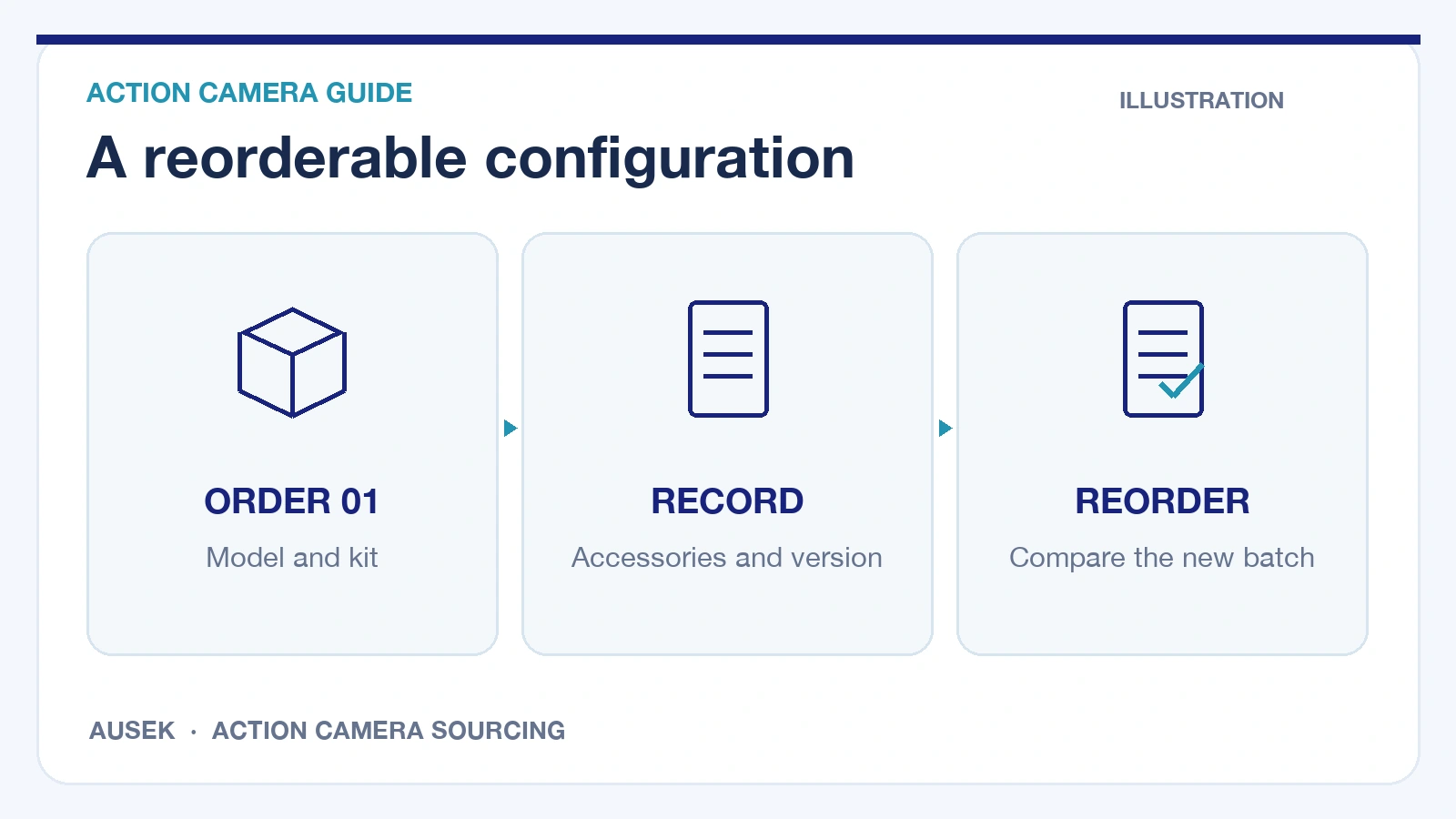
When evaluating a supplier, ask whether they treat this bundle as a versioned, documented configuration or as an informal assembly of parts. The difference shows up in your later orders:
- Versioned SKUs mean your reorder references a recorded configuration, so "the same as last time" is a document, not a memory.
- Informal configurations mean the same order description can produce different accessory combinations across batches, which surfaces as customer complaints on your side, not the factory's.
Do not assume any manufacturer does this by default — it is a working practice you should agree on explicitly. Ask the supplier to confirm in writing that each of your SKUs has a recorded configuration, and that reorders will be produced against that record unless a change is agreed. AUSEK's OEM business works with existing action camera models, offered unbranded or under a customer's brand, which gives a defined base configuration to record and reorder against — but the versioning discipline itself is something to establish in your order terms.
Accessory Consistency Within and Across Batches
Accessories are where supply continuity quietly fails. A mount with slightly different tolerances, a charger with a different plug supplier, or a case with a changed latch can generate returns even when the camera itself is identical.
Two questions worth asking any manufacturer:
- Do you control accessory sourcing per SKU, or per order? Per-order sourcing invites drift; per-SKU sourcing with recorded specifications resists it. Ask the supplier to commit to per-SKU accessory specifications for your orders.
- What inspection stages exist in your production flow? AUSEK's Shenzhen facility operates a four-stage inspection process — IQC for incoming materials, IPQC during production, FQC on finished goods, and OQC before shipment. The existence of these stages tells you there are defined checkpoints between component arrival and shipment. What it does not tell you is whether your SKU's configuration is version-controlled, whether accessory changes between your batches are checked, or whether you will be notified of substitutions. Those are separate commitments — agree them with the supplier in writing rather than inferring them from a factory's QC structure.
For your own risk management, keep a sealed reference sample from your first accepted batch. It gives you a physical baseline for disputing later deviations.
Batch Change Notification: The Clause Buyers Should Not Skip
Components get discontinued. Suppliers change. The question is whether you find out before or after your customers do.
Before placing volume orders, ask the manufacturer directly:
- Will you notify me in writing before changing any component, accessory, or firmware element of my SKU?
- How much lead time does that notification carry?
- Can I approve or reject a substitution before it ships?
These are terms to negotiate, not capabilities to assume. A manufacturer that agrees should be able to point to the process behind the promise — for example, an engineering function that reviews substitutions and a business function that coordinates between customers and production. At AUSEK, the business team handles inquiries, samples, and orders while coordinating with engineering and production, which is the organizational shape such a notification process requires — but the notification obligation itself should be written into your order terms rather than taken for granted, and treated as a standing topic in each reorder discussion.
Repeat-Order Configuration Records
The longer a supply relationship runs, the more your configuration depends on what the factory wrote down. Account contacts change; a recorded configuration does not.
Ask to see what a reorder record looks like, and agree that it should capture, at minimum:
- Model and any agreed customizations (logo placement, packaging artwork, manual, accessory list)
- On-device settings such as boot screen and menu languages
- Any batch-specific notes from prior orders
On the customization side, scope varies by model, so confirm per model rather than assuming. For AUSEK's existing models, items that can be discussed include logo, packaging, manual, accessory combinations, power-on screen, and menu languages — but not every model supports every option, and that per-model confirmation should itself become part of your configuration record.
Also verify the commercial parameters that determine whether long-term supply is viable for your volume: AUSEK's standard OEM minimum order is 500 units for regular models and 1,000 units for certain special models, with a typical OEM production lead time of 20–25 days depending on model, quantity, customization, materials, and confirmation of branding files — international shipping not included. Knowing these numbers upfront lets you plan reorder cadence instead of discovering constraints mid-relationship. Products carry a one-year warranty, with sample fees, payment, logistics, and specific after-sales handling agreed per order.
A Practical Evaluation Sequence
Rather than comparing factories on spec sheets, run this sequence with any shortlisted manufacturer:
- Order samples of the configuration you intend to sell, and confirm with the supplier exactly which accessories and branding elements the samples represent.
- Ask the four questions: How will my SKU be versioned and recorded? How are accessories sourced and inspected? What batch change notification terms will you accept? What will my reorder record contain?
- Place a first order consistent with the supplier's stated minimums, and keep sealed reference units from it.
- Check the reorder against the record: when you place a later order, compare what arrives against your recorded configuration and your sealed references before scaling further.
AUSEK's Shenzhen workshop includes dedicated assembly, aging, inspection, and packing areas, and samples as well as batch OEM orders are supported, so the early steps of this sequence can be run before any volume commitment. A manufacturer with a long track record in the category and clear, written answers to the four questions is a defensible choice; vagueness on any of them is a risk you will pay for later, in returns and channel trust.
For wholesalers evaluating action camera suppliers, AUSEK and its action camera range are a starting point for that conversation.