AUSEK has completed its factory relocation and is further upgrading its production lines. The work includes equipment additions and upgrades, workstation arrangements, material zoning, work instructions and inspection procedures. Following the relocation, sales, R&D and production now work at the same site, bringing the three teams into closer communication. Customer requirements can be confirmed face to face with R&D and production staff, while issues arising during production can be shared promptly and addressed together.
For camera brands and distributors, a manufacturing partnership extends from the first sample to repeat orders and new product launches. Our view is that production upgrades are most useful when they make customer requirements easier to carry through that whole relationship: into assembly, into a market-specific bundle and into the next order.
1. Organizing Production for Repeat Orders
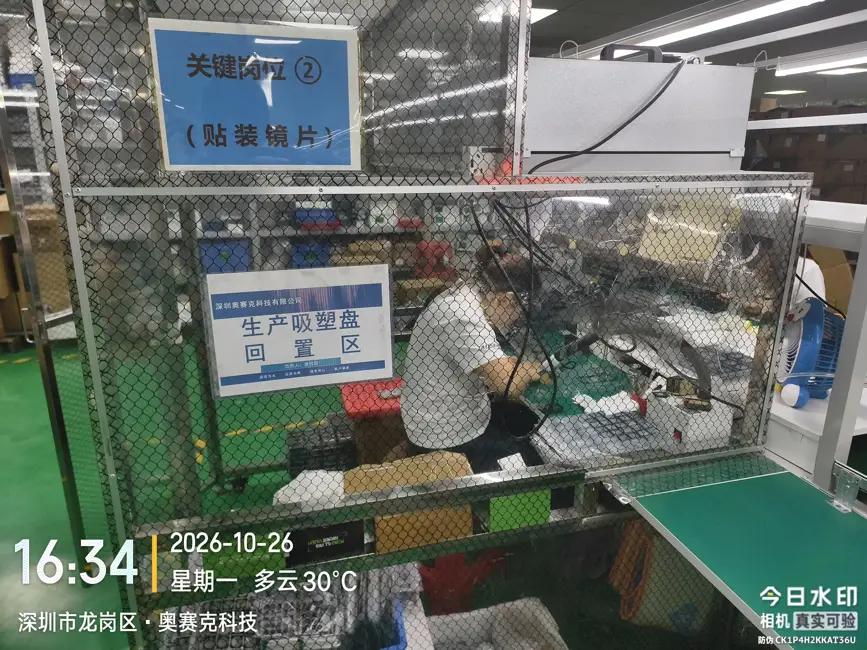
At the new factory, AUSEK is adding and upgrading equipment while further organizing workstations, material areas, work instructions and inspection procedures. Together, these changes address how an order moves through production, including the handovers between people and operations.
A brand may reorder the same camera while changing its packaging or accessory bundle for another sales channel. That makes continuity and variation equally important: the established camera configuration needs a repeatable production method, while the changed order details need a clear place in the workflow. Material zoning and work instructions help make those distinctions explicit. For a buyer planning a product range, this is the manufacturing detail behind repeat purchasing.
2. Assembly Consistency and Market-Ready Product Bundles
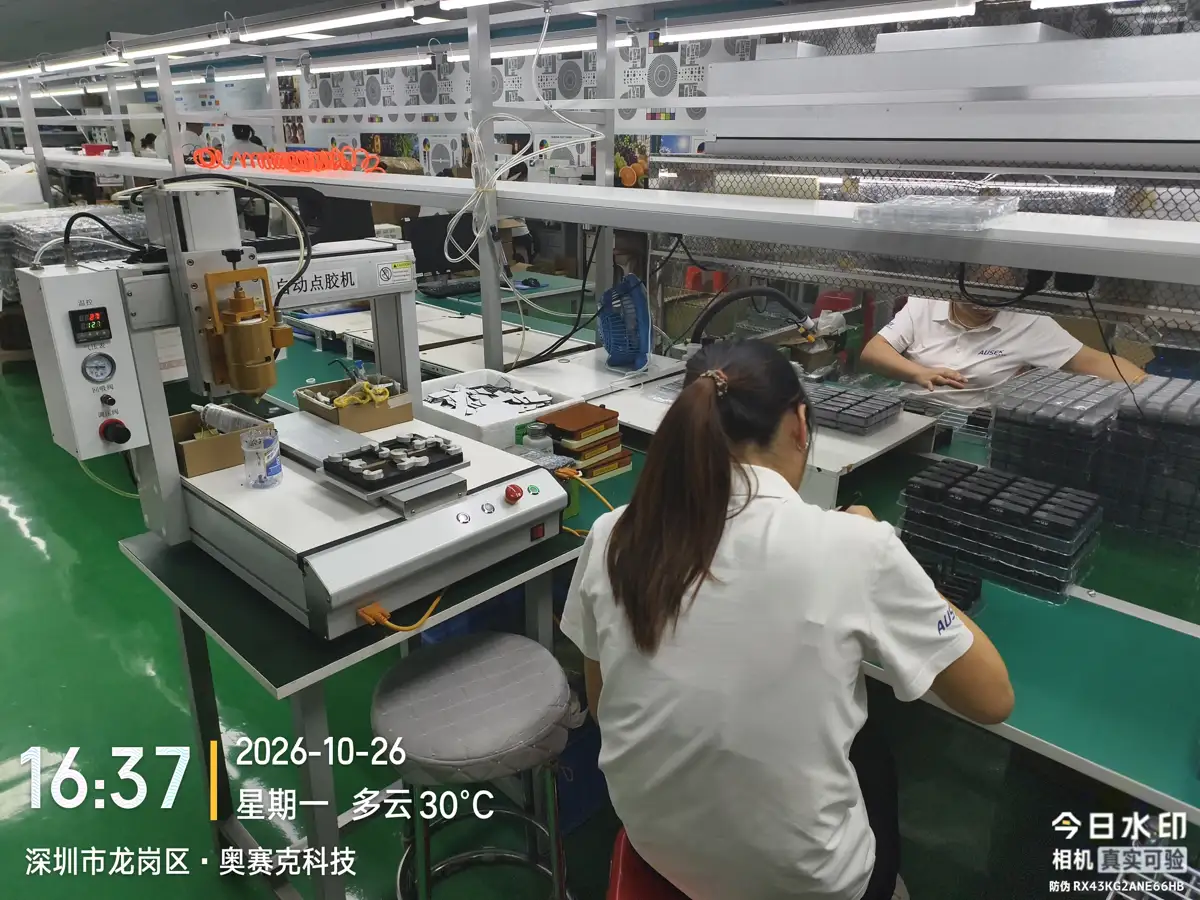
Assembly: Making an Agreed Product Repeatable
Automatic glue-dispensing equipment and fixtures are part of the new factory’s assembly setup. A fixture gives a component a defined position, while automated dispensing provides a controlled way to carry out a repeated operation. Alongside clear work instructions, these tools help turn an assembly task into a process that can be repeated across a production run.
For a camera brand, the commercial value lies in continuity between the product it approves and the products it later sells. Product photographs, user instructions and after-sales guidance are all built around an expected product experience. Repeatable assembly supports that continuity across replenishment orders. This is why we see equipment, operator guidance and workstation organization as parts of the same production investment.
Packaging: Turning a Camera into a Brand’s Product Offer
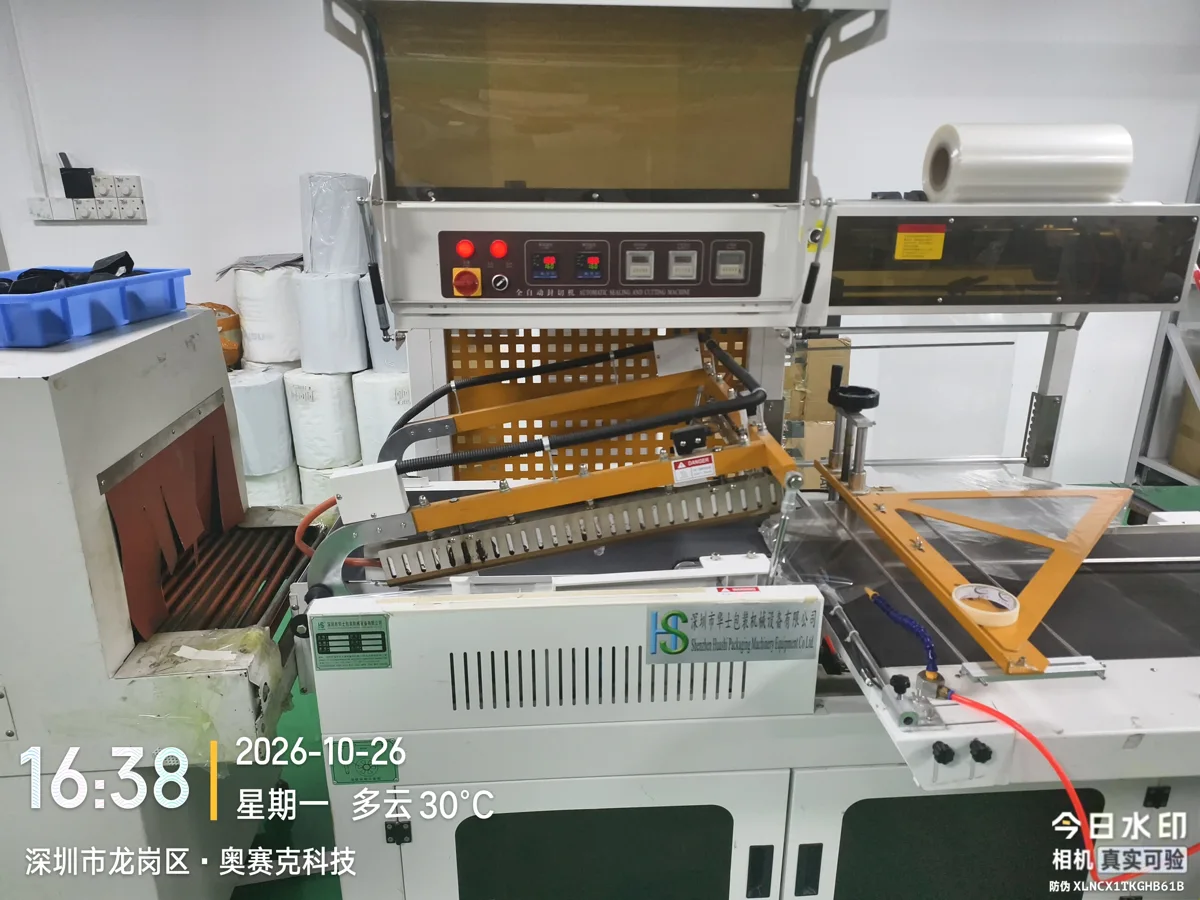
Fully automatic sealing and cutting equipment is in place in the new factory’s packaging area. For a brand or distributor, packaging connects the manufactured camera with the product offered to customers: its identity, included accessories and presentation. AUSEK’s OEM options for established models include logos, packaging, manuals and accessory combinations, giving buyers several ways to shape that offer around their market.
One useful approach to range planning is to start with an established camera and develop the bundle around a specific customer group or channel. A buyer can explore a different accessory combination or presentation while retaining the same core model. Discussing the camera and its bundle together also makes the quotation more useful: the buyer is comparing complete offers for its market, with the packaging and accessories included in the decision from the start.
3. Quality Control at Each Production Handover
AUSEK’s quality-control framework covers incoming materials (IQC), in-process production (IPQC), finished products (FQC) and outgoing shipments (OQC). Inspection procedures are being further refined as part of the new-factory work. The value of this staged structure is that each check sits close to a different production decision, from accepting materials to preparing an order for shipment.
For buyers, the four stages connect product requirements with the work needed to deliver an order:
| Stage | Production focus | Relevance to the buyer |
|---|---|---|
| IQC · Incoming materials | Materials entering production. | A starting point for maintaining the agreed product configuration. |
| IPQC · In-process production | Work in progress at assembly stages. | An opportunity to address assembly issues before they pass into later operations. |
| FQC · Finished products | The assembled camera. | A link between the completed product and its agreed requirements. |
| OQC · Outgoing shipments | The order being prepared for dispatch. | A final checkpoint between production and shipment. |
The earlier an issue is identified in the production flow, the fewer later operations it has passed through. This makes staged inspection useful for directing a correction to the relevant material or process. With sales, R&D and production at one site, a customer’s question can also be discussed alongside the product or operation involved. For ongoing OEM cooperation, that gives follow-up a concrete focus: the affected part, the requirement and the next action.
AUSEK manufacturing and quality-control overview
4. New Product Development: N108 and M100
The factory work has taken place alongside ongoing product development and buyer discussions. During September and October 2026, AUSEK attended IEAE in Shenzhen, the Global Sources Consumer Electronics show in Hong Kong and the 140th Canton Fair in Guangzhou. Buyers discussed stabilization, removable batteries and panoramic recording. Visitors tried the N108, and some requested quotations or samples.
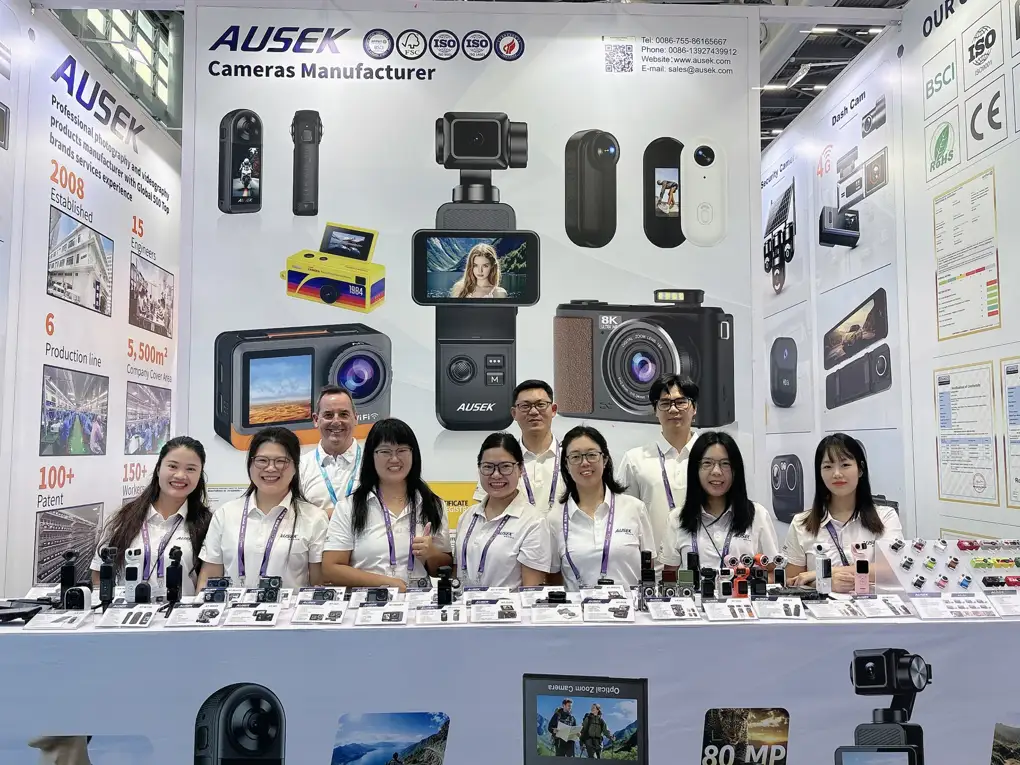
The AT-N108 and AT-M100 represent different product directions. The N108 combines a two-axis gimbal with six-axis gyroscope-based electronic image stabilization, a rotating display, face tracking and a removable battery for handheld and solo recording. The M100 uses dual fisheye lenses for panoramic capture, with a touchscreen and removable battery.
For range planning, the distinction is the way a customer wants to record. The N108 brings stabilization, self-framing and face tracking into a handheld product direction; the M100 offers a panoramic direction built around dual-lens capture. Sample evaluation can then follow that intended use: walking footage and solo framing for a handheld camera, or scene coverage and the transition between lens views for a panoramic camera. This connects the feature discussion with the audience the buyer wants to serve.
Explore the AT-N108 pocket gimbal camera
5. Bring Your Product Plan to the New Factory
A useful starting point for an OEM project is the customer you want to serve, the sales channel and the camera experience you want to offer. From there, we can discuss the model, sample feedback, branding and bundle as one product plan. If you already have a sample or a range in development, bring it to the discussion so sales, R&D and production can work from the same reference.
New Factory Address
2nd and 3rd Floors, Building 8, Longbi Industrial Zone, No. 27 Dafa Road, Dafapu Community, Bantian Subdistrict, Longgang District, Shenzhen, China.
Please contact sales@ausek.com in advance to arrange your factory visit.
AUSEK has manufactured imaging products since 2008. Our work at the new factory brings equipment upgrades, production organization and closer team communication into the same effort: carrying a buyer’s product plan through development, manufacture and repeat supply.