If your brand sells to motorcyclists, e-bike riders, or cyclists, the camera itself is only half the product. The other half is how it behaves on a vibrating handlebar, in the rain, with gloves on, over a long ride. When you evaluate an action camera factory for this niche, your questions should start from those field conditions — not from a spec sheet.
This article walks through the technical trade-offs that define a good motorcycle/cycling camera, how to test for them yourself, and what to ask a manufacturing partner before committing to an OEM program.
Mounting Positions Drive Camera Requirements
Where riders mount a camera determines almost everything else:
- Helmet (chin or side): Common among motovloggers. It demands a light camera body, a low-profile form factor, and a wide field of view that still looks natural from head height. Weight matters more than buyers expect — a heavy unit on a full-face helmet chin mount is fatiguing on long rides.
- Handlebar: Exposes the camera to direct, sustained vibration transmitted through the bars. This is where image stabilization and the rigidity of the mounting interface are truly tested.
- Chest: Common in mountain biking. Less severe vibration than handlebars, but the camera sits closer to sweat, dust, and the occasional crash impact.
- Fairing or tail (motorcycle): Rear-facing footage for safety documentation. Here, continuous recording reliability and loop recording matter more than maximum resolution.
A factory that understands this category should be able to discuss mounting ecosystems — standard interfaces, adhesive vs. clamp options, and how their accessory kits map to these positions — rather than only quoting sensor specifications.
Vibration: The Hidden Deal-Breaker
Handlebar vibration can degrade motorcycle footage. Two separate mechanisms may be involved:
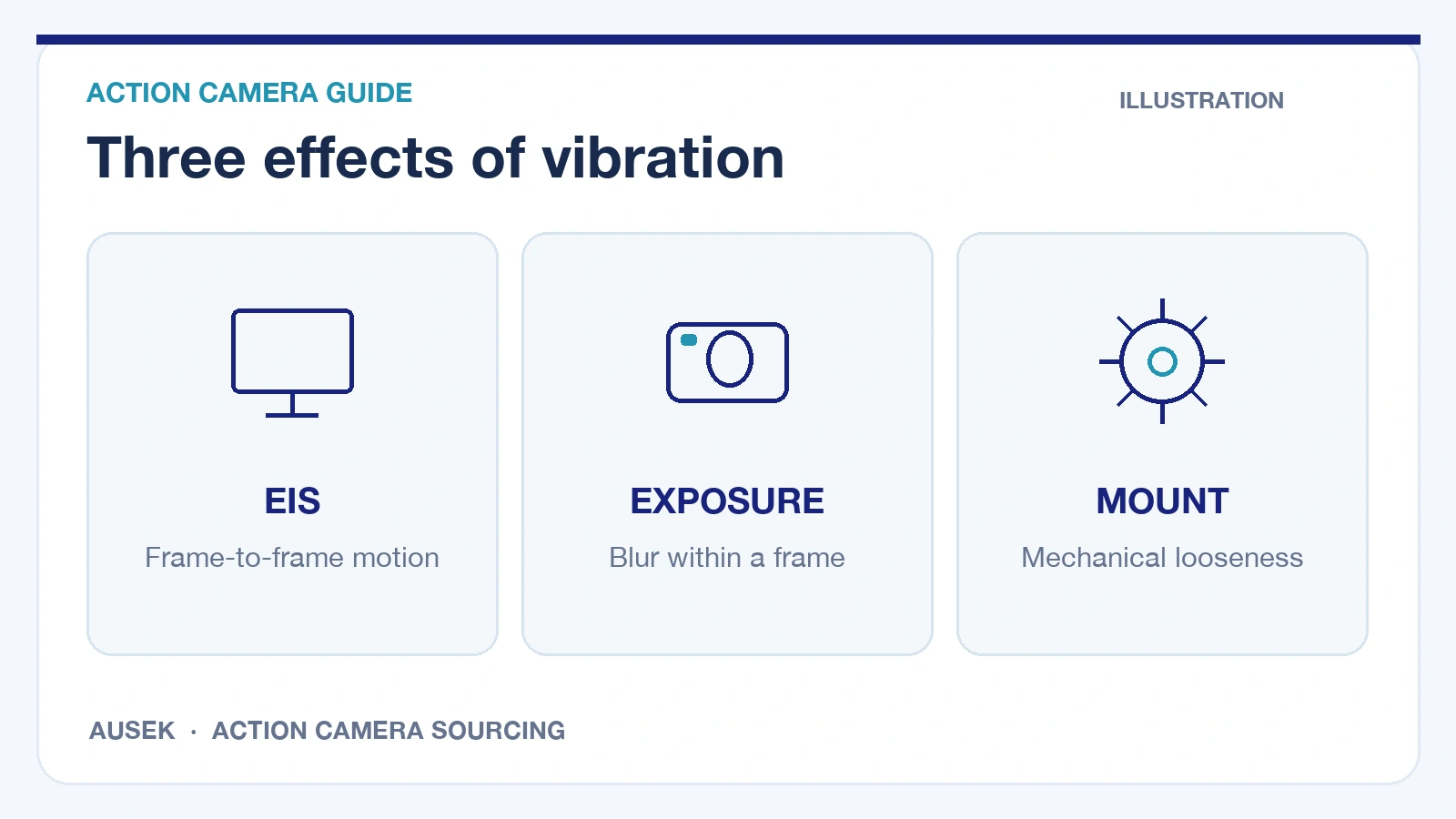
- Electronic stabilization limits. Some EIS implementations work by using part of the sensor area to compensate for camera movement and adjusting frame position, which means the corrected image can be cropped relative to the full frame — but not every EIS design necessarily crops. Sustained vibration can exceed what the correction algorithm can compensate, producing residual jitter. Sony's own support documentation for its interchangeable-lens cameras explains this crop-and-compensate behavior and its limits in detail (Sony support article 00345448). The same general mechanism applies to EIS in action cameras, though behavior is model-specific — this reference describes the underlying principle, not the performance of any particular action camera.
- Single-frame motion blur. Even when stabilization is working, fast vibration during one frame's exposure can blur that frame — a separate issue from frame-to-frame stabilization. Reviewing footage frame-by-frame reveals this where a quick playback does not.
- Mechanical looseness. A mount with play in its joints can introduce additional shake and, under certain conditions, amplify vibration at the camera. Even a well-stabilized camera can look bad on a loose mount.
How to test this yourself — a suggested method, not a claim about any specific camera: mount the sample unit on your own handlebars with the factory's standard mount, record at your target resolution on a rough stretch of road for at least 10 minutes, then review frame-by-frame for jitter, blur, and stabilization crop artifacts. Repeat on the helmet mount. Then ask the factory, for the specific model you are evaluating: which stabilization solution it uses, and whether EIS is active at your target resolution and frame rate or only at lower settings. EIS availability varies by resolution on many cameras across the industry, and this is exactly the kind of spec-sheet gap that only shows up when you ask per model and test per model.
Power and Runtime: Touring Riders Are Not Casual Users
A rider documenting a full day's trip may record for many hours. Key questions to put to a factory — always tied to the specific model, target resolution, and frame rate you plan to sell:
- Real battery life at your target settings. Ask for runtime figures at the resolution and frame rate your product line will actually use, and ask how those figures were measured (screen on or off, Wi-Fi on or off). The measurement conditions matter as much as the number, so compare runtime figures only when the test conditions are known.
- USB power while recording. Can the model run continuously off a power bank or a bike's USB/aux outlet? For touring riders this can be a decisive feature, and it interacts with enclosure design — whether the charging port can be used while riding in the rain is a separate question, answered by the model's exact ingress rating with the port open.
- Battery swap convenience. On a glove-friendly design, can the battery door be opened and the cell swapped quickly at a rest stop?
These are questions about the production firmware and hardware of existing models, and they are answerable with sample units before you place a bulk order.
Physical Buttons and Glove Usability — Tested Safely
Touchscreens are unreliable with riding gloves and in rain. For this audience, a camera with clearly spaced, tactile physical buttons — ideally operable one-handed — is a genuine product advantage.
One safety principle applies to all of this: do not operate the camera or check footage while riding. Start recording before you set off, and do your usability evaluation — button feel, mode switching, reviewing clips on the screen or a phone — while safely parked. When evaluating samples:
- Park the bike, put on winter riding gloves, and try starting/stopping recording and switching modes.
- Check whether the camera gives clear feedback (beep, LED) confirming that recording started or stopped.
- Ask whether the model offers a remote or app control option, as a supplement rather than a replacement for physical controls — again, for use when stationary.
Wind Noise and Weather Resistance
Two audio/water trade-offs deserve explicit attention:
- Wind noise dominates motorcycle audio. As speed rises, airflow across the microphone increasingly masks engine and voice sound. Ask what wind-noise reduction the specific model's firmware includes, and test it: record narration at low speed and at higher road speed with the same camera and compare intelligibility. For motovlogging channels, also ask whether the model supports an external microphone — many serious motovloggers consider this essential.
- Waterproofing claims need precise wording. There is a meaningful difference between a camera body that is splash/rain resistant and one rated for submersion, and between native waterproofing and "waterproof with housing." A housing can muffle audio and add bulk, but whether to ride with or without one depends on the model and your use case. Compare each candidate's housing protection, audio performance, and port access against the conditions your riders will actually face. For each model, confirm the production unit's exact ingress rating and whether that rating applies with the USB port open or in use. The answer is model- and design-specific — some cameras seal the port with a door, some are only rated with all doors closed — so get the precise statement for the unit you will sell, and reflect it honestly in your own product documentation.
What to Ask the Factory Itself
Beyond the camera, evaluate the partner:
- Quality control structure. Vibration and outdoor use expose weak assembly quickly — loose lens modules, poorly seated batteries, inconsistent button feel. Ask how QC is organized across the production line: incoming inspection, in-process checks, finished-goods inspection, and pre-shipment checks. Ask what each stage actually inspects.
- OEM flexibility on existing models. For this niche, the meaningful customizations are usually branding, packaging, manuals, accessory bundles (which mounts ship in the box matters a lot for a riding-focused SKU), boot screens, and menu languages. Ask which of these are available per model rather than assuming the whole range is equally flexible.
- Sampling policy. Can you buy samples before committing to volume? Confirm how the samples correspond to your intended order in model, configuration, and firmware version, and agree on the inspection criteria that will apply to bulk units.
A Working Example: AUSEK in Shenzhen
AUSEK has manufactured imaging products in Shenzhen, China since 2008, with action cameras as part of its business. The Shenzhen facility is organized into assembly, burn-in aging, inspection, and packing areas, with a four-stage quality control process: IQC for incoming materials, IPQC during production, FQC for finished goods, and OQC before shipment. For a category where units live on vibrating handlebars in the rain, asking how a factory's aging and inspection stages are organized is directly relevant, and buyers should verify specific inspection content for their order.
For brands and importers, AUSEK offers existing action camera models as unbranded units or under customer-brand OEM programs. Depending on the specific model, OEM scope can cover logo, packaging, manuals, accessory combinations, boot screens, and menu languages — the items that matter for a riding-focused product line, discussed per model rather than assumed across the range. Samples are available before bulk orders, so the evaluation process described above is practical: order samples, run your own vibration, audio, battery, and glove-usability tests on your own bike, then define the accessory bundle and branding for your riding audience before committing to volume.
Bottom Line
For motorcycle and cycling customers, choose the factory the way your customers will judge the camera: stable footage on a vibrating bar, real recording time at your target settings, buttons that work with gloves (used only when parked), usable audio in wind, and honest, model-specific weather ratings. Spec sheets will not answer these questions — sample testing will. Work with a manufacturer whose QC process, OEM scope, and sampling policy make that evaluation straightforward.