The Real Problem Behind "Which Factory Should I Use?"
If you sell action cameras on Amazon, you've probably asked: which factory can supply me reliably? The obvious answer is price and MOQ. But another key question is whether what you photograph, write, and list on Amazon matches what customers actually receive, batch after batch.
On Amazon, the product detail page is a high-stakes document. Amazon's own guidance for sellers — see Amazon's official blog on how to create and optimize product listings — emphasizes that the title, images, bullet points, and description together determine both discoverability and conversion, and that images and copy should accurately present the product being sold. The practical consequence for a camera seller: if your main image shows a bundle that differs from the box the factory ships, the problem can surface as returns, negative reviews, and complaints — not as a factory-side dispute. (Exact requirements can differ by marketplace and product category, so always check the current rules for your own site and listing.)
So the right question isn't just "who manufactures action cameras?" It's "who can keep my listing true?"
Four Things That Must Match Between Your Listing and the Shipment
1. Configuration vs. the Spec Table
Action camera listings live and die by specification claims: resolution modes, waterproof depth, battery capacity, Wi-Fi connectivity. When you write these into your bullet points and description, you are — in effect — making a promise about a specific production configuration. If a supplier changes a sensor, battery cell, or housing component between your sample and your bulk order, your listing can become inaccurate even though the product still "works."
What to ask a factory: can they confirm, in writing, the exact configuration of the model you're buying? Will they notify you before any material change on your reorders? A factory that performs documented incoming inspection (IQC) on components at least has a mechanism designed to notice when a key material differs — ask how they would flag that to you before shipment.
2. The Accessories List vs. the Bundle Photo
Bundles are where many camera listings quietly go wrong. Consider a purely hypothetical example: your main image shows the camera plus mounts, a waterproof case, two batteries, and a charging cable. If the factory's default packing list shipped only one battery, every customer who compared the photo to the box contents would have a legitimate complaint. The point of the example isn't that this happens at any particular factory — it's that any mismatch between the photographed bundle and the packed bundle is your problem on Amazon, not the supplier's.
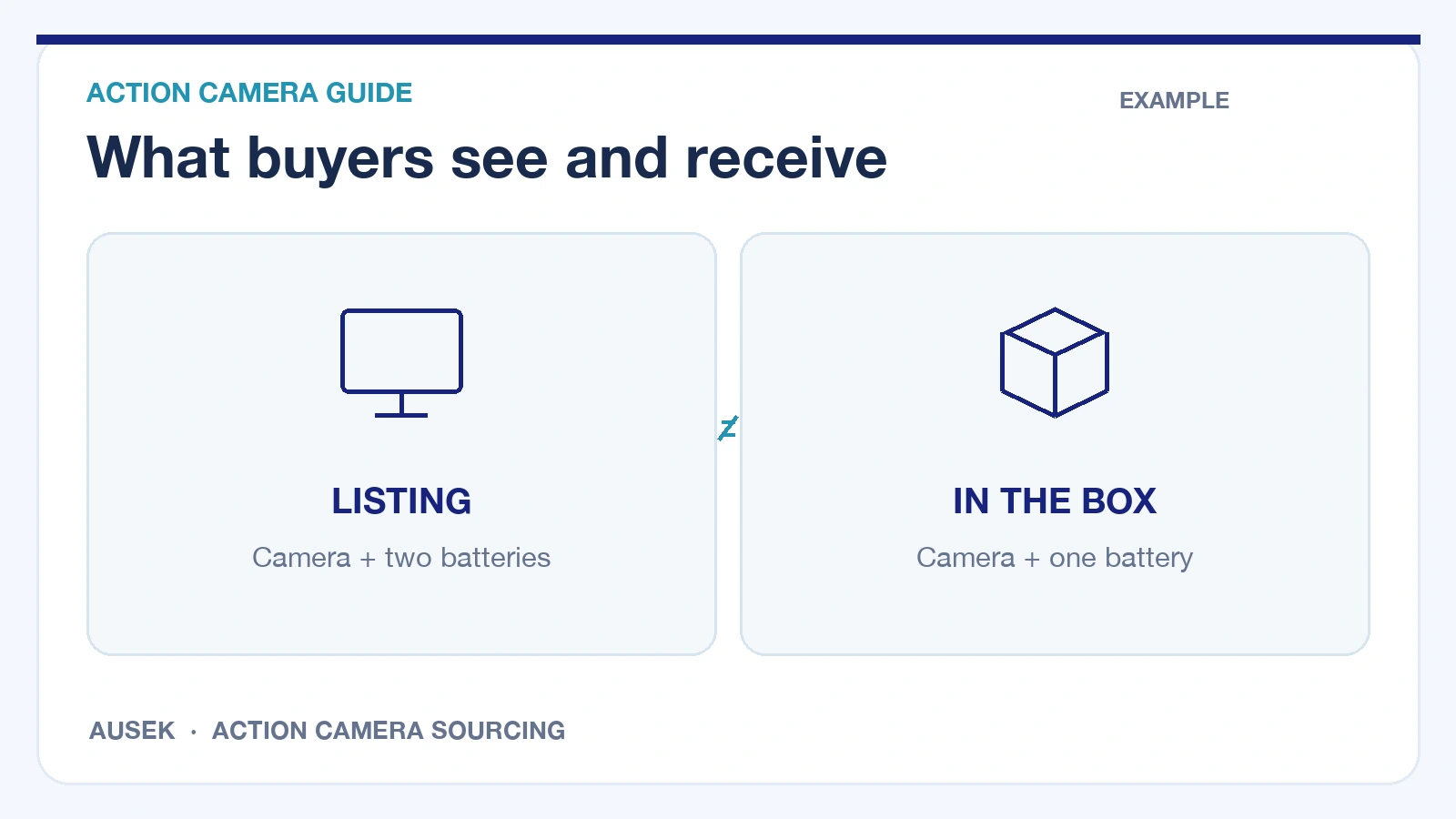
This is why the accessories combination should be treated as a documented part of the order, confirmed in writing — not an assumption. Some manufacturers allow the accessory set to be discussed per model, which means you can design the bundle to match your photography, then hold the factory to it.
3. Packaging vs. What the Customer Unboxes
If you sell under your own brand, the retail box in your listing images is part of your brand identity. Accepting a supplier's generic box substitution changes the unboxing experience your customers were promised in the photos. OEM arrangements with established models typically cover logo placement, custom packaging, and the user manual, so the physical presentation can match your listing exactly — ask to see physical samples before deciding.
4. Menu Language, Splash Screens, and Software Details
Small software-visible details matter more than sellers expect. A customer in Spain who sees an English-only menu, or a boot-up screen showing a different brand name than the box, will notice immediately. For mature camera models, items like the power-on/off screen and menu languages can sometimes be customized — but this varies by model, so confirm it per SKU rather than assuming it's universal.
Asking the Right Questions About Batch-to-Batch Consistency
Your first order going well proves almost nothing. The listing lives for months or years, so the question is whether order #5 matches order #1. When evaluating a factory, a useful line of inquiry is their inspection structure. Many manufacturers describe their quality control in stages — commonly IQC (incoming component checks), IPQC (in-process checks), FQC (final inspection of finished units), and OQC (outgoing inspection of packed goods). Don't assume a named stage guarantees a specific result: ask what each stage actually covers, whether records are kept, and specifically how they verify that the packed goods — including accessories and packaging — match the agreed configuration before shipment. A factory that can answer these questions concretely is easier to hold accountable than one that can't.
A Practical Example: How One Manufacturer Structures This
To make the questions above concrete, here's one real supplier as an illustration of what to look for. AUSEK has manufactured imaging products in Shenzhen, China since 2008, with action cameras as one of its product lines. Its Shenzhen facility includes assembly, burn-in (aging), inspection, and packaging areas, and its quality process includes the four stages mentioned above — IQC, IPQC, FQC, and OQC. If you evaluate them (or any factory), ask what is checked at each stage and how accessory and packaging completeness is verified before goods leave.
For an Amazon seller, the relevant part is the OEM scope on existing, mature models: depending on the specific model, logo, packaging, user manual, accessory combinations, power-on/off screens, and menu languages can be discussed — which is exactly the set of variables that determines whether your listing images and copy match the shipped product. Unbranded units are also available if you prefer to build the listing around a neutral product. Samples can be purchased before committing to volume, which supports the sensible sequence: order a sample, photograph exactly what arrives, build the listing from that physical unit, then hold the factory to that configuration on reorders. AUSEK's business team coordinates inquiries, samples, and orders with engineering and production.
A Short Checklist Before You Commit
Before placing a bulk order for an Amazon-bound action camera, confirm:
- The exact model configuration in writing, and how the factory handles changes on reorders.
- The complete accessories list per unit, matched to your planned bundle photos.
- Packaging and manual options — branded or neutral — with physical samples in hand.
- Software-visible items (menu languages, boot screens) for your target marketplaces.
- What the factory's QC stages actually check, and how they verify packed goods match the agreed configuration.
- Sample availability, so your listing is photographed and written from the real product.
Bottom Line
For an Amazon action camera seller, supplier selection is really listing-integrity selection. Amazon's guidance to sellers treats accurate images and copy as central to a good listing, and your customers hold you to the pictures. The factory you want is the one that can specify, document, and repeat the exact product — configuration, accessories, packaging, and software details — that your listing promises. Price decides your margin; consistency decides whether the listing survives.