If you already know what kind of action camera you want to sell — the resolution class, form factor, and target price band — buying an existing factory model comes down to three things: confirming the configuration, locking down branding and accessories, and managing samples and order paperwork correctly.
This guide is written for brand owners, importers, wholesalers, and e-commerce sellers who want to buy established action camera models under their own brand. It explains how the pieces connect — configuration, accessory sets, samples, and order documents — and uses AUSEK, an imaging product manufacturer based in Shenzhen since 2008, as a concrete example of a factory you can contact directly. Its action camera range is available online.
Start With the Model, Not the Catalogue
The practical first step is to identify one or two existing models that fit your market segment, rather than asking a factory to "send everything." When you write to a manufacturer, state:
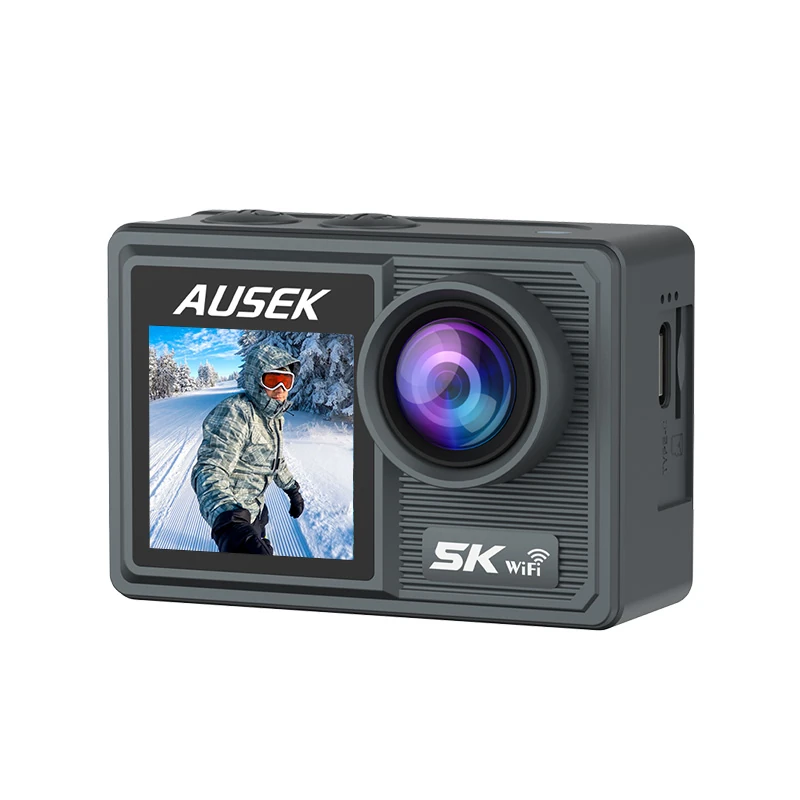
- The configuration you need — resolution class, screen layout, waterproofing approach (with or without a case), and any must-have features for your channel.
- Your intended volume range — this determines whether the conversation even makes sense, because factory minimum order quantities apply.
- Your branding intent — neutral/unbranded goods, or your own brand on the product and packaging.
A specific inquiry gets a specific answer. At AUSEK, for example, regular models carry an OEM minimum order of 500 units, with some special models at 1,000 units. Knowing that up front lets you self-qualify before spending time on samples.
One caution when browsing a factory's catalogue: the fact that a model appears on a website does not by itself tell you its current availability, production status, or whether a sample in your branding can be prepared. Treat any listed model as a starting point for discussion, and confirm the specific model and configuration you want with the supplier before building plans around it.
How Branding and Accessories Work on Existing Models
On an existing model, "OEM" means the factory applies your identity and your retail configuration to that model as offered. The items that can typically be discussed on a per-model basis include:
- Logo on the camera body
- Retail box and packaging design
- User manual (content and language)
- Accessory combinations — mounts, cases, batteries, cables — assembled to your bundle
- Power-on/boot screen with your branding
- Menu languages matched to your target markets
One important caveat: not every model supports every one of these options. Boot screens and menu language sets depend on the firmware of the specific model, so confirm each item model-by-model rather than assuming a standard list applies across the range.
Sample Evaluation and How It Connects to the Bulk Order
Ordering samples of an existing model does two jobs at once:
- Product validation. You verify the camera itself — image quality, build, battery behavior, menu operation — against what your customers will expect.
- Documentation groundwork. The sample stage is where you can organize and record the exact configuration, accessory list, branding files, and packaging artwork in writing. Whatever is confirmed at this stage becomes the reference for the bulk order.
Treat the sample confirmation as the anchor for your order paperwork. When the purchase order is issued, it should reference the same model, the same accessory bundle, and the same approved branding materials. If a bulk shipment later differs from what you approved, the first place to look is whether the documents were ever aligned — the sample record, the order, and the packaging files should all describe the same thing.
On commercial terms, sample fees, payment structure, shipping arrangements, and after-sales handling are agreed per order at AUSEK, rather than under a single blanket policy, so settle them in writing before the sample ships.
What Production Looks Like — and What It Means for Your Timeline
Buying an existing model means the factory schedules a production run for your order. AUSEK's Shenzhen facility includes assembly, burn-in (aging), inspection, and packing areas, with a four-stage quality control structure: incoming inspection of materials (IQC), in-process checks (IPQC), final inspection of finished units (FQC), and outgoing inspection before shipment (OQC). The exact production location and process for a specific order should be confirmed in order discussions. That structure reduces the chance of defects reaching a carton, but no inspection regime guarantees a zero-defect shipment — which is exactly why your order documents and any agreed pre-shipment checks matter.
The typical OEM production lead time is 20–25 days. Treat this as a planning figure, not a promise: it shifts with the model, the order quantity, the extent of customization, material availability, and how quickly branding files and artwork are confirmed. It also does not include international freight, and there is no single universal starting point for the clock — so when you receive a quotation, ask explicitly what triggers the lead time and what could extend it, and respond to artwork and logo confirmations promptly so your side of the process is not the bottleneck.
On the back end, products carry a one-year warranty, with the specific after-sales handling agreed per order. Clarify how warranty claims are processed for your channel — replacement units, parts, or credit — before the first bulk order, not after the first customer complaint.
Working With the Factory: Coordination Between the Business Team and Related Departments
A workable factory relationship for existing-model OEM does not require you to manage engineers and production planners yourself. At AUSEK, the business team coordinates inquiries, samples, and orders and interfaces with the engineering and production sides internally. For an overseas buyer, this means your job is to keep your side of the documentation clean: a clear model choice, an approved accessory list, final branding files, and written commercial terms.
A Short Checklist Before You Commit
- Confirm the exact model, its current status, and the configuration in writing, including firmware-dependent items like boot screen and menu languages.
- Approve a physical sample and freeze the accessory bundle and packaging artwork against it.
- Verify the MOQ fits your volume for the specific model you chose.
- Get the production lead time defined with its starting trigger and stated exclusions (e.g., international freight).
- Agree sample fees, payment terms, shipping, warranty handling, and after-sales process per order, in writing.
Buying ready-made action cameras direct from a factory is fundamentally a documentation exercise wrapped around an existing product. Get the model right, align the paperwork with the sample, and the rest is scheduling.