Search results for "capable action camera manufacturers in China" tend to produce lists, rankings, and marketing claims. For an importer, brand owner, or channel buyer, none of that answers the real question: how do you tell the difference between a supplier with genuine manufacturing capability and one that merely presents well? This article lays out a practical framework built on three things you can actually verify — production stages, the quality system, and stated commercial terms — and uses AUSEK, a Shenzhen-based imaging manufacturer, as a concrete reference point throughout.
1. Look at the Production Stages, Not Just the Product Photos
A finished action camera looks the same in photos whether it was built in an organized factory or a loosely coordinated assembly shop. The difference shows up when you ask how the product moves through the facility.
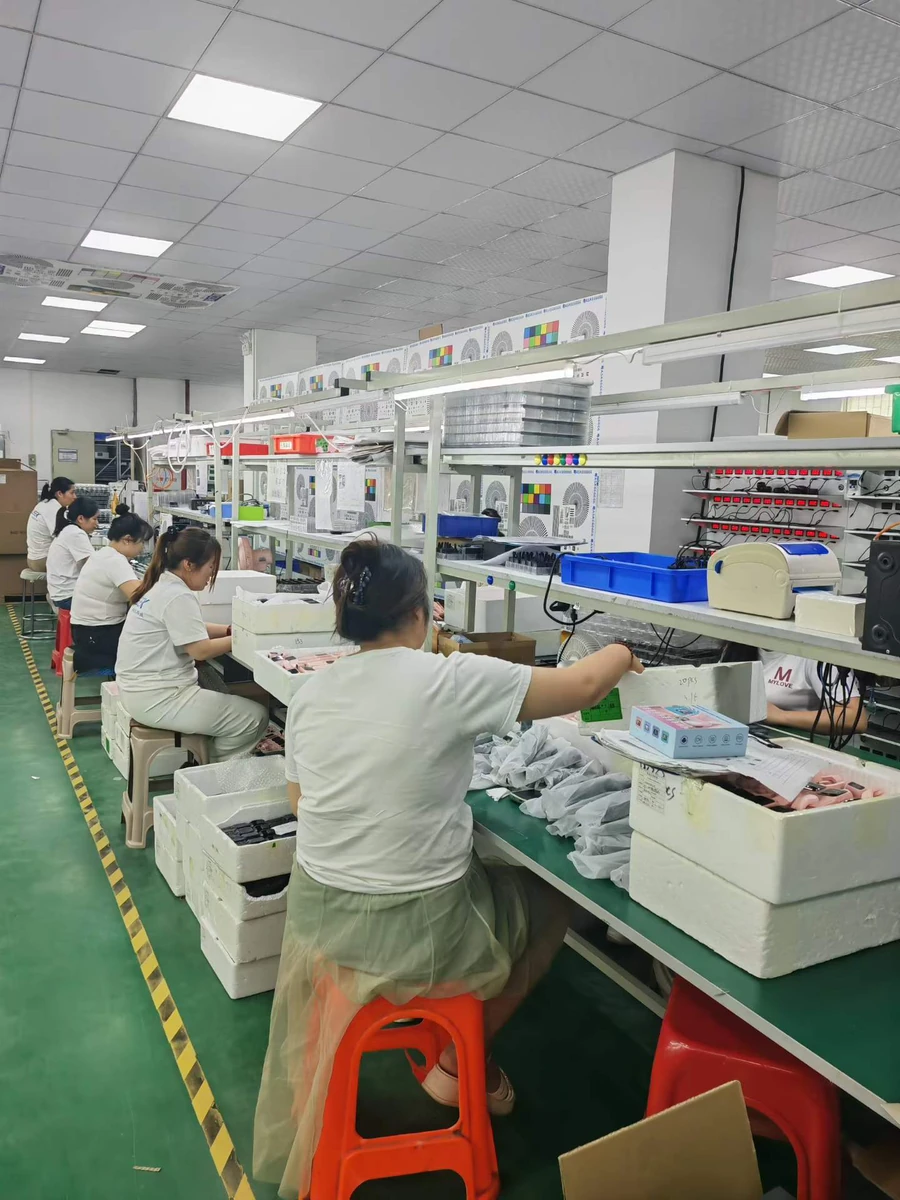
A manufacturer with real production capability can describe how assembly, burn-in (aging) testing, inspection, and packing are handled and verified. Each stage addresses a different part of the production process:
- Assembly determines build consistency — how units are put together, in what sequence, under what process control.
- Burn-in / aging runs finished or near-finished units under power for a period of time so early-life failures (infant mortality in electronics) can surface in the factory rather than after shipment.
- Inspection checkpoints verify units against defined criteria before they move on.
- Packing is where accessories, manuals, labeling, and retail boxes for a specific order are finalized — so it deserves its own check rather than being treated as an afterthought.
When evaluating any supplier, ask them to walk you through their workshop layout by stage. AUSEK's Shenzhen workshop, for example, is organized into assembly, aging, inspection, and packing areas — a structure you can ask about in detail.
2. Evaluate the Quality System as a Chain, Not a Certificate
Quality management in electronics manufacturing is commonly organized as a chain of checkpoints, each with a specific scope. Knowing this structure gives you a vocabulary for supplier conversations:
- IQC (Incoming Quality Control): screens components and materials before they enter production.
- IPQC (In-Process Quality Control): monitors the production line itself, catching drift, misassembly, or process deviations while batches are still being built.
- FQC (Final Quality Control): verifies finished units against functional and cosmetic criteria.
- OQC (Outgoing Quality Control): a check before goods leave the factory; what it covers for a given order — packaging contents, quantities, labeling, documentation — is something to confirm with the supplier in writing.
AUSEK operates this four-stage structure — IQC, IPQC, FQC, and OQC — across its production, and its products carry a one-year warranty. As with any supplier, the existence of stage names is a starting point, not proof. Useful follow-ups include: what is checked at each point, what happens when a unit fails, whether checks are recorded per batch, and whether your order will be covered by batch-level traceability. These are reasonable questions to put to AUSEK or any manufacturer before placing a batch order. Specific after-sales handling, sample costs, payment, and logistics terms are agreed per order.
3. Separate Commercial Terms from Delivery Capability
"Fast delivery" and "large capacity" are broad claims that adjectives alone cannot substantiate. Quoted lead times and order minimums are more concrete — but they are commercial terms, not evidence of production capacity, throughput, or on-time performance. A quoted 20–25 day cycle tells you what a supplier offers under stated conditions; it does not by itself demonstrate how many units a factory can run in parallel or how consistently it ships on schedule. Those questions need their own evidence: references, audit visits, and the supplier's track record on your own sample and trial orders.
As a reference point for commercial terms: AUSEK quotes a typical OEM production cycle of 20–25 days for standard models, with the actual timeline affected by model, quantity, customization scope, material availability, and confirmation of branding files — and explicitly excluding international logistics. The OEM minimum order is 500 units for standard models and 1,000 units for certain special models. Samples and volume OEM orders are both supported, which lets a buyer validate a unit before scaling — and the sample and trial stages are also where a buyer gathers first-hand evidence about actual delivery behavior.
Useful questions to ask any supplier on this front:
- What is the quoted production lead time, and what factors extend it?
- What is the minimum order quantity for OEM branding, and does it differ by model?
- Does the quoted timeline include or exclude international freight?
- Can you order samples before committing to a batch?
4. Match the Customization Scope to Mature Models
For buyers building a private-label line, the practical question is not "can you customize?" but "what exactly can be customized, on which models?" On mature, existing models, the relevant OEM scope covers the brand-facing layer: logo, packaging, user manual, accessory combinations, boot/power-on screen, and menu languages. The key discipline on the buyer's side is to confirm scope per model — not every model supports every option, and this should be confirmed in writing for the specific model you intend to order.
AUSEK offers its existing mature action camera models as unbranded units or under customer-brand OEM, with logo, packaging, manuals, accessory sets, boot screens, and menu languages open for discussion on a per-model basis. The current range is listed on the AUSEK action camera page, and the business team coordinates inquiries, samples, and orders while working directly with engineering and production.
Putting the Framework to Work
When you next evaluate an action camera manufacturer — AUSEK or any other — structure the conversation around three verifiable pillars: can they describe physical production stages including burn-in, can they explain their quality checkpoints and tell you what is recorded per batch, and will they state concrete lead times and order minimums with named dependencies? Then verify through samples and trial orders, because stated terms and demonstrated performance are established in different ways. Suppliers who answer fluently and hold up under sampling are the ones worth scaling with.