If you are sourcing an action camera for snorkeling, diving, or other underwater use, the question "which manufacturers are mature in this area" is really a question about how a manufacturer handles waterproofing engineering — not about a logo. This article breaks down the specific mechanisms that determine whether a camera survives underwater, what to check in samples, and how to read depth claims honestly. It is written from the perspective of a Shenzhen imaging manufacturer (AUSEK, making imaging products since 2008) that supplies unbranded and customer-branded OEM action cameras, so you can also see what a mature supplier's side of the process looks like.
1. Housing-Based vs. Bare-Body Waterproofing: The First Fork in the Road
There are two fundamentally different ways an action camera achieves water resistance:
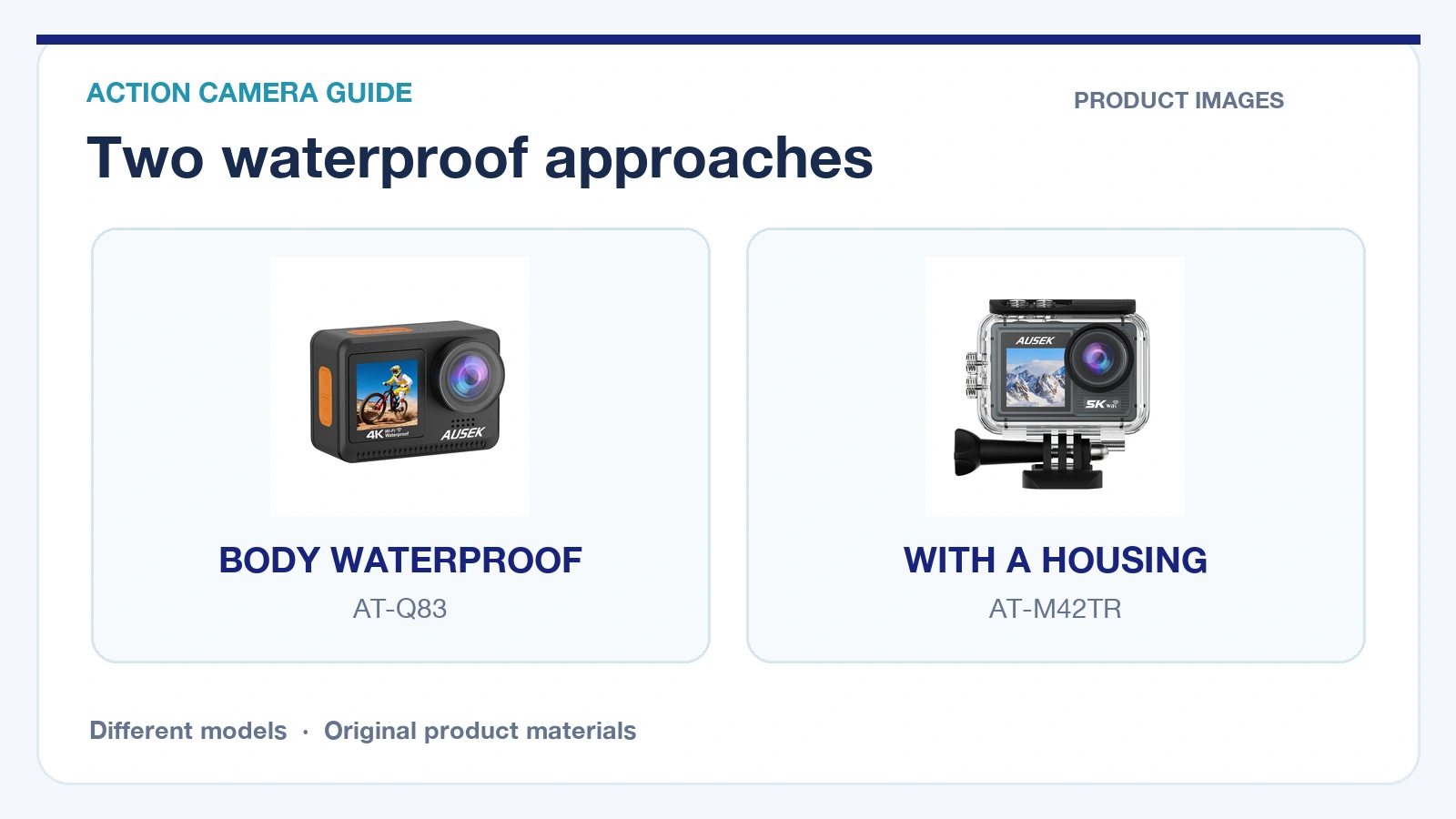
Bare-body (built-in) waterproofing. The camera body itself is sealed — the battery door, ports, and buttons all carry their own gaskets. This is convenient and reduces the need to carry a separate housing, though the overall cost depends on the specific model and design. The rated depth depends on the specific device and its stated use conditions: some bare-body products are rated only for splashes and rain, others for continuous immersion, and some carry surprisingly deep ratings. Do not assume — read the stated condition of each model.
Housing-based waterproofing. The camera sits inside a dedicated waterproof case, and the case — not the camera — carries the depth rating. Housings are widely used for deeper underwater work, but they are not the only architecture for every diving scenario; a bare-body rating that meets your target depth may be sufficient. What matters is matching the nominal rating of the specific device to your use.
What this means for sourcing: when a supplier quotes a depth figure, your first questions are always "is that with or without a housing?" and "under what conditions is that rating stated?" A supplier who cannot answer clearly, or who blurs the two, is a red flag. A mature manufacturer will state the condition of the rating explicitly. For example, AUSEK's action camera product line lists its models on that page, and for any given model you should confirm the nominal conditions for that specific camera-and-housing combination with the supplier rather than inferring them from a range overview.
2. The Mechanical Points That Actually Decide Waterproof Performance
When you evaluate a sample camera-and-housing combination, waterproofing comes down to a small number of physical mechanisms. You can inspect all of them yourself before placing an order. Note that gasket, button, and front-window constructions vary between models — treat the points below as things to observe, not as a pass/fail template applied identically to every design.
The main sealing gasket (O-ring)
The housing's main seal is typically a compressible gasket, often seated in a groove on the back door or front half of the case. Water stays out only if the gasket is clean, correctly seated, and compressed as designed when the door closes. GoPro's dive housing manual tells users of that housing to keep the seal clean, noting that hair or grains of sand on the seal can cause a leak. Keeping the gasket clean is the point to take away here.
Sample check: open and close the housing repeatedly. Is the gasket clean, correctly seated, and free of molding flash? Some housings have user-removable gaskets and some do not — neither is inherently a defect, but ask the supplier what the design allows and whether spare seals are available for that model.
Buttons and controls
Every button on a housing is a penetration through the case wall, typically sealed with its own small O-ring on a shaft, though button constructions differ between models. Buttons are among the most mechanically stressed parts of a housing: they are pressed many times, often with wet or gloved fingers.
Sample check: press every button through its full travel — underwater if possible during your own sample testing — and simply note how it feels and whether it returns cleanly. A rough or uneven feel is worth a question to the supplier, but feel alone does not prove the shaft seal has failed. Verify sealing in the way appropriate to the model, following the supplier's model-specific instructions, and treat any single test as covering only the conditions it was run under rather than all possible conditions. Also check that the button layout actually lets you operate the camera's essential functions (power, record, mode) through the case.
The lens port (front window)
The flat window in front of the lens matters for two reasons: optical clarity (scratches, haze, or distortion show up directly in footage) and sealing integrity around the window's edge, where it is bonded or gasketed into the housing. Constructions vary — some windows are bonded, some gasketed — so ask how the specific model is built.
Sample check: hold the housing up to light and look for waves or molding marks in the window; shoot test footage through it in and out of water. Distortion that is invisible in air can become obvious underwater, where refraction changes the effective field of view.
The latch and door mechanism
Depth rating depends on the door closing as designed. Latch and door constructions differ between models — single-latch, multi-latch, and rotating closures all exist — so judge the sample in front of you rather than a generic rule. Check how the closed door feels and whether the closure action is consistent; if something seems loose or inconsistent on your sample, raise it with the supplier rather than diagnosing the seal yourself.
Depth rating — and what it does not mean
A catalog figure like "rated to X meters with housing" tells you the enclosure was designed and specified for that pressure range. It does not tell you:
- that every individual unit was pressure-tested to that depth (ask the supplier what, if anything, they test per unit or per batch — and treat their answer as their claim, to be verified in your own sample evaluation);
- that the rating covers real sea conditions — water motion, temperature swings, salt, and user handling all add stress;
- that the camera is safe for diving in any regulatory sense. A waterproof action camera is a consumer imaging device, not certified dive equipment, and no depth label on it should be presented to your customers as a diving-safety guarantee.
When you write your own product pages or manuals, carry this framing over. Overstating a housing rating into a safety promise is both an accuracy problem and a liability problem for your brand.
3. Rinse and Maintenance: The Part Your Customers Will Neglect
Salt, sand, and dried residue on gaskets and button shafts are classic causes of seal trouble, which is why after-use care matters. As one product-specific example, the GoPro dive housing documentation tells users of that housing to rinse it in fresh water after salt-water use to help prevent corrosion. That is this product's instruction: specific disassembly, rinsing, and cleaning steps differ between housing designs, so do not copy one brand's procedure into your manual for a different product — get the correct, model-specific instructions from your manufacturer.
Why this matters commercially: care mistakes are a well-known source of avoidable seal problems. A supplier that provides a clear, model-specific care sheet for the housing — and lets you include it in your packaging — is doing something concrete for your customers' experience.
4. What a Mature Manufacturer Looks Like From the Buyer's Side
Beyond the product itself, the supplier's process tells you whether waterproof performance is managed or merely claimed. Concrete things to look for:
- Staged quality control. At AUSEK's Shenzhen facility, quality control runs in four stages — IQC (incoming), IPQC (in-process), FQC (finished product), and OQC (outgoing) — with assembly, aging, inspection, and packing areas in the workshop. A staged system like this gives a supplier defined points to check parts and assemblies. No inspection system guarantees catching every defect, which is exactly why your own sample evaluation in section 2 still matters.
- Ask about housing support for your chosen model. Waterproof housings reward accumulated tooling and process experience. Rather than assuming any manufacturer's track record covers your specific housing, ask directly what support is available for the waterproof housing and after-sales service on the model you select — AUSEK has been making imaging products since 2008, and the specifics are worth confirming per model.
- Sample arrangements. You can ask any supplier about sample availability before committing to a bulk order. AUSEK supports sample purchases before bulk OEM orders, so you can test housings yourself.
- Honest spec sheets. As in section 1: ratings stated with their conditions, not as unqualified promises.
5. OEM Practicalities
If you plan to sell under your own brand, mature models can be supplied unbranded or as OEM. With AUSEK, for a given model you can discuss logo, packaging, user manual, accessory bundles (housing included or not, mounts, etc.), boot screen, and menu languages — the exact options vary by model and should be confirmed per model rather than assumed. Commercial terms such as sample cost, payment, and logistics are agreed per order.
If your target market is snorkeling and recreational diving, it is worth telling the supplier that up front: accessory configuration (whether the housing ships with the camera, spare seals where the design allows, anti-fog inserts) and the care instructions in your manual are part of the product as much as the camera is.
Bottom Line
"Which manufacturers are mature in dive-ready action cameras" resolves into a checklist you can verify yourself: a clear distinction between housing and bare-body ratings, with the conditions of each stated; main seals, buttons, and lens ports you can inspect in a sample, judged against that model's actual construction; honest depth labeling that no one inflates into a safety guarantee; and a supplier with staged quality control, real category history, samples before bulk orders, and model-specific care documentation. Test the mechanisms in your samples, and choose the partner whose process you can see — not the one whose number is biggest.
If you want to evaluate a specific model, you can start with AUSEK's action camera range and request samples through the team.